Impressions Up, Clicks Down in Google Search Console: 6 Causes and How to Fix Each (2027)
Quick answer: When Search Console shows impressions rising while clicks fall, it usually means Google is showing your pages more often but people aren’t clicking. The four most common reasons in 2026–27 are AI Overviews answering the query on the page, impressions shared across several sources inside AI answers, rankings for many new queries on page 2 or lower, and bot or AI-agent queries inflating impressions. Weak titles and irrelevant queries make it worse. Each cause has a different fix, so diagnose first.
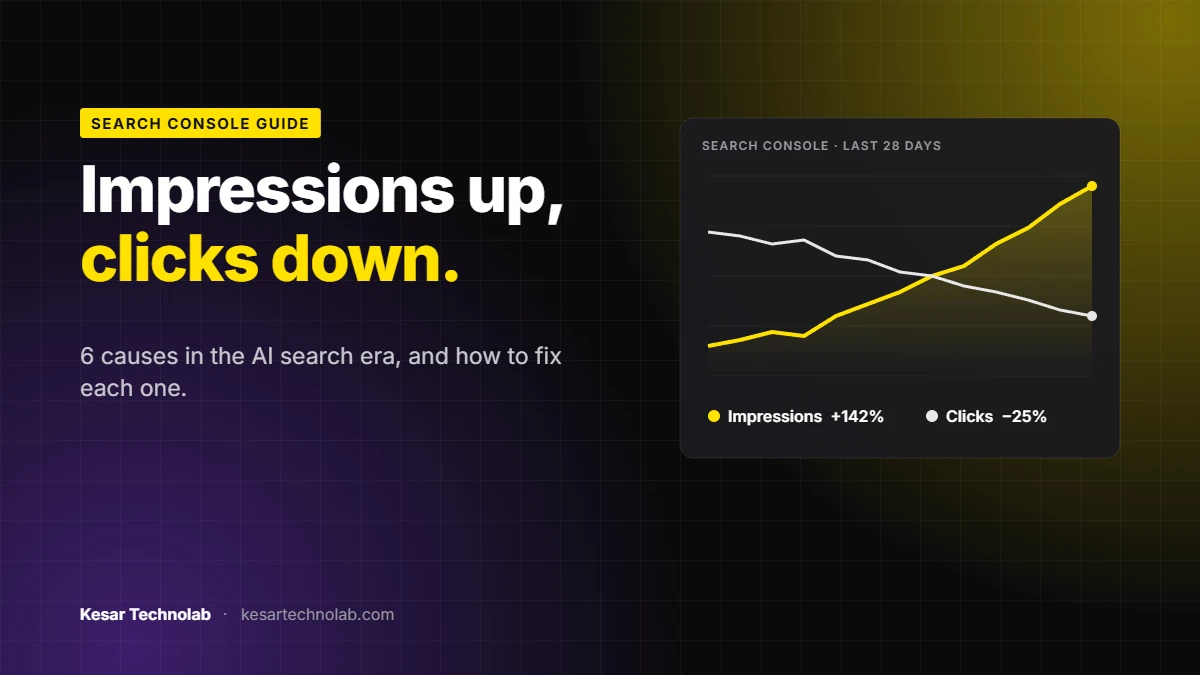
If your Performance chart looks like an open crocodile mouth, with the impressions line climbing and the clicks line flat or falling, you’re not alone. Ahrefs called it “the great decoupling”: across sites it studied, clicks and impressions used to rise and fall together, but in the first half of the year the correlation turned negative (−0.352). An April 2026 analysis by Rocket Agency of 150 Australian businesses found impressions up 43% in a year while clicks fell 2.5%.
We saw it on our own site too. Over 28 days to November 2026, kesartechnolab.com had 6,800 impressions (+142%) and 6 clicks (−25%). Here’s what we found when we took it apart, and what to do about it.
First: what an impression actually is
Search Console counts an impression when your link appears in results a person loads, whether in the blue links, inside an AI Overview or in another search feature. A click is counted only when they visit your site. CTR is clicks divided by impressions.
So more impressions with fewer clicks doesn’t automatically mean you’re doing worse. It means you’re being seen in more places where people don’t need to, or can’t easily, click.
The 6 causes
1. AI Overviews and AI Mode answer the question for them
This is the biggest driver for informational queries. An Ahrefs study published in February 2026 found that AI Overviews correlate with a 58% lower click-through rate for top-ranking pages, nearly double the drop it measured a year earlier. A randomized field experiment with 1,100 Google users found that AI Mode sharply reduced clicks to outside websites.
Typical symptom: “What is”, “how does” and “trends” queries with steady positions but CTR collapsing.
2. Your impressions are shared inside AI answers
A classic number-one ranking gives impressions to one URL. An AI Overview can cite several URLs at once, and each cited page gets an impression. Ahrefs suggests this is a likely reason many sites’ impressions increased while clicks didn’t follow.
Typical symptom: Impressions jump on queries where you never ranked well in the blue links.
3. You rank for more queries, but on page 2 or lower
As your site publishes more, Google tests it against more long-tail queries, usually at positions 20–60. Each test counts as an impression; almost none earn a click. Total impressions climb while average position quietly worsens.
Typical symptom: Average position getting worse while impressions rise; hundreds of queries with 1–5 impressions each.
4. Bots and AI agents are inflating impressions
Automated tools query Google constantly: rank trackers, scrapers, and now AI agents breaking a user’s question into sub-queries. When Google disabled the num=100 results parameter in September 2025, 87.7% of sites in one 1,000-property sample saw impressions drop, which shows how much of the old number was automated. Months later, SEOs reported very long prompt-like queries appearing in Search Console alongside impressions rising again.
We found this in our own data: a query beginning “17. how much does ai engine optimization cost, and what should a business expect to pay…”. That’s a numbered prompt from a tool, not something a person typed.
Typical symptom: Queries of 10+ words, numbered or question-list style, with 1–2 impressions and zero clicks.
5. Your titles and snippets don't earn the click
If you rank on page one and still get no clicks, the snippet is losing. Common problems: titles cut off on mobile, generic titles (“Ultimate Guide to…”), a year stuck on every title without any real update, and meta descriptions that repeat the title instead of promising a specific outcome.
Typical symptom: Position 3–8, impressions in the hundreds, CTR under 1%.
6. You show up for queries that aren't yours
Competitor brand names, unrelated meanings of a word, and navigational searches for other sites all count as impressions but will never click through to you. On our site, a competitor agency’s brand name produced more impressions than most of our real topics.
Typical symptom: Your top queries by impressions include brands or topics you don’t sell.
How to diagnose your site in 20 minutes
- Compare like with like. Search Console → Performance → Date → Compare: last 3 months vs the previous 3 months (and vs the same period last year if you have the data). Short windows on small sites are mostly noise.
- Split by position. Export queries and group them: positions 1–5, 6–10, 11–20, 21+. If most new impressions are at 21+, it’s cause 3.
- Find bot-style queries. Query filter → Custom (regex) →
(\S+\s+){9,}\S+shows queries with 10 or more words. If many have 1–2 impressions and no clicks, discount them (cause 4). - Check page-one pages with low CTR. Filter for position below 10 and sort by impressions. CTR under 1% at positions 3–8 means fix the snippet (cause 5) or check for an AI Overview on that query (cause 1).
- Search the top queries yourself in a private window. Is there an AI Overview? Are you cited? What do competing titles promise?
- Remove irrelevant queries from your analysis (cause 6) before calculating your real CTR.
- Check Analytics for the outcome that matters: leads and sales from organic search, not just sessions.
How to fix each cause
| Cause | Fix | Time to impact |
|---|---|---|
| 1. AI answers the query | Shift effort to queries where people need to click: pricing, comparisons, tools, templates, case studies. On informational pages, aim to be the cited source: answer in the first 50 words, add original data, use clear headings and FAQ schema. | 4–12 weeks |
| 2. Shared AI impressions | Track AI citations as their own KPI. A cited mention builds brand recall even without a click, so watch branded search growth too. | Ongoing |
| 3. Page-2+ rankings | Consolidate thin overlapping posts into one stronger page, add internal links from your best pages, and earn a few relevant links. | 6–16 weeks |
| 4. Bot impressions | Nothing to fix. Exclude them when reporting so your decisions rest on human data. | Immediate |
| 5. Weak snippets | Rewrite titles: [Specific outcome] + [number or proof] + [qualifier], under ~60 characters. Example: “AEO vs SEO Agency: 5 Questions That Decide It (+ Costs)”. | 2–6 weeks |
| 6. Irrelevant queries | Ignore them, or tighten the page’s topic so Google stops testing it for unrelated searches. | — |
When to worry, and when not to
| What you see | Worry? |
|---|---|
| Impressions up, clicks flat, leads flat or up | No. That’s the new normal on AI-heavy queries. |
| Impressions up, clicks down, leads down | Yes. Fix causes 3 and 5 first; they’re the most fixable. |
| Clicks down on your money pages (pricing, services) | Yes, urgently. These queries should still earn clicks. |
| Sudden impression spike from 10+ word queries | No. It’s mostly automated traffic. |
What to measure instead of clicks alone
- Qualified conversions from organic search (forms, bookings, calls) in GA4.
- CTR on page-one queries only, which removes the noise from page-2 tests and bots.
- AI citations: run the same 20 buyer questions in ChatGPT, Gemini, Perplexity and Google AI Mode every month and log whether you’re named.
- Branded search volume: people who saw you in an AI answer often search for you by name later.
FAQ
Why are my impressions going up but clicks going down?
Usually because Google shows your pages more often in places where people don’t click: inside AI Overviews, for long-tail queries on page 2 or lower, or to bots and AI agents. Weak titles and irrelevant queries also lower CTR.
Do AI Overviews count as impressions in Search Console?
Yes. If your page is linked in an AI Overview that a user sees, Search Console counts an impression. Google doesn’t report AI Overview clicks separately from regular results.
What is a good CTR in 2027?
It depends on position and whether an AI Overview appears. Instead of chasing an industry average, compare each page with itself over time and focus on page-one queries.
Can bots inflate Google Search Console impressions?
Yes. Automated rank trackers, scrapers and AI agents trigger impressions without any human seeing your result. Long, prompt-like queries with one or two impressions are the usual sign.
Want to know if AI is answering for you, or about you?
We’ll run 20 real buyer questions about your category through ChatGPT, Gemini, Perplexity and Google AI Mode, and show you who gets named, who gets cited, and where you’re missing. Get your free AI Visibility Snapshot →