
Salla vs Zid vs Shopify (2026): Which Ecommerce Platform Should Saudi Brands Choose?
Quick answer: If you are comparing Salla vs Zid vs Shopify for a Saudi-only store, Salla or Zid is usually faster and cheaper to launch. Local payments such as mada, Apple Pay, STC Pay, Tabby and Tamara come built in, along with ZATCA e-invoicing support. Shopify is the better fit when you sell across the GCC or internationally, need a deep app ecosystem or want more control over growth. Budget for third-party gateway fees, because Shopify Payments is not available in Saudi Arabia.
Choosing between Salla, Zid and Shopify is one of the first big decisions a Saudi ecommerce brand makes, and it is expensive to reverse. The platform decides how you take payments, how you comply with ZATCA, how well you rank in Arabic search, how easily you can expand to the UAE or Kuwait, and how much you pay every month.
This guide compares Salla vs Zid vs Shopify for Saudi retailers, D2C brands and distributors in 2026. It includes a decision matrix you can score yourself, a compliance checklist and a migration plan if you are already on the wrong platform.
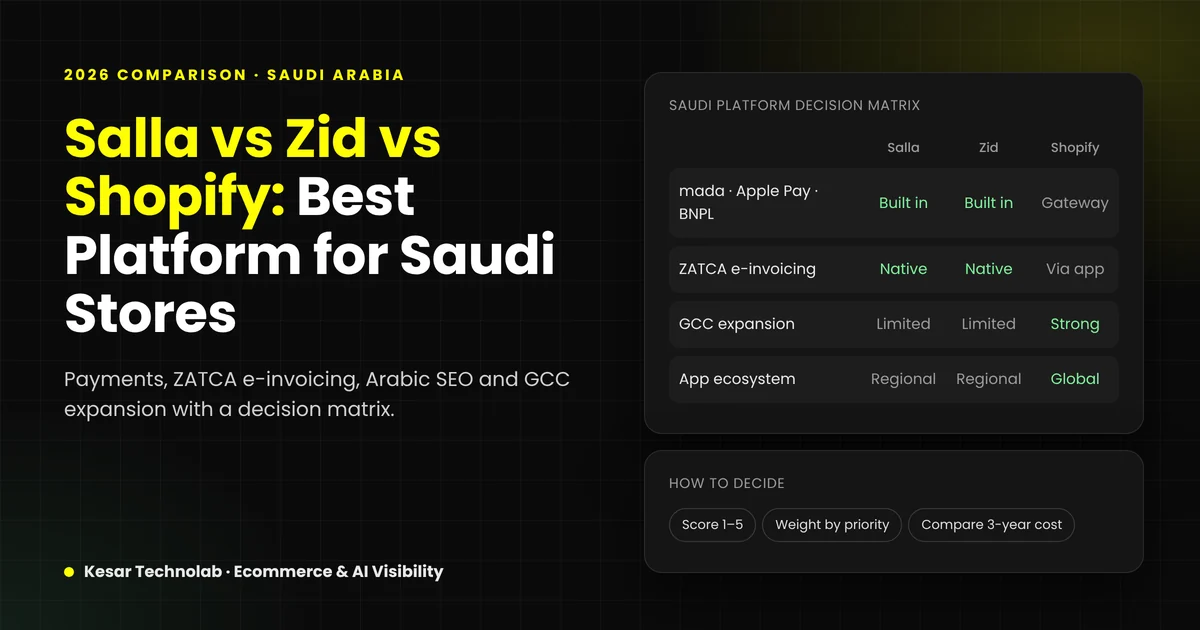
Salla vs Zid vs Shopify: The Quick Verdict
| If you are… | Usually best fit | Why |
|---|---|---|
| A new Saudi brand testing demand | Salla or Zid | Low entry cost, local payments and ZATCA tools included, Arabic-first setup |
| A growing Saudi-only retailer with standard needs | Salla or Zid | Local operations are simpler; check that SEO and integration limits will not hold you back |
| A brand selling across the GCC or internationally | Shopify | Multi-market selling, larger app and theme ecosystem, international payment and logistics options |
| A brand with complex integrations (ERP, PIM, custom logic) | Shopify, or WooCommerce/custom | More mature APIs and partner ecosystem |
| A B2B or wholesale business | Depends on requirements | Test B2B pricing, quotes and invoicing workflows on each platform before committing |
Side-by-Side Comparison for the Saudi Market
| Factor | Salla | Zid | Shopify |
|---|---|---|---|
| Origin | Saudi platform, Arabic-first | Saudi platform, Arabic-first | Global platform (Canada) |
| Entry pricing | Free starter tier; paid plans from around SAR 100/month* | Free starter tier; paid plans from around SAR 100/month* | Basic from USD 39/month (monthly billing); Plus from USD 2,300/month |
| Local payments (mada, Apple Pay, STC Pay, BNPL) | Built in | Built in | Through third-party gateways and apps |
| Shopify Payments | – | – | Not available in Saudi Arabia |
| Platform surcharge with external gateway | Check current terms | Check current terms | 2% Basic, 1% Grow, 0.6% Advanced, 0.2% Plus |
| ZATCA e-invoicing | Native tools | Native tools | Requires a third-party app or middleware |
| Multi-country selling | Primarily Saudi-focused | Primarily Saudi-focused | Strong (Markets, multi-currency, multi-language) |
| App and theme ecosystem | Growing, regional | Growing, regional | Very large, global |
*Pricing reflects published 2026 comparisons at the time of writing. Check each platform’s current pricing and terms before deciding.
Payments in Saudi Arabia: Why This Decides Most Cases
Saudi shoppers expect mada, Apple Pay and, increasingly, buy-now-pay-later through Tabby or Tamara. Missing one of these at checkout costs you sales, regardless of how good the store looks.
Salla and Zid offer these methods as part of the platform. On Shopify, a Saudi-registered business cannot use Shopify Payments, so you connect a third-party gateway. Shopify then adds a transaction surcharge on top of the gateway’s own fee: 2% on Basic, 1% on Grow, 0.6% on Advanced and 0.2% on Plus. Check Shopify’s pricing page for current rates.
Expert insight: calculate the surcharge before choosing Shopify. At SAR 1,000,000 in annual online sales, Shopify Basic with an external gateway adds about SAR 20,000 a year in surcharges, before gateway fees. On Grow it is about SAR 10,000. That does not rule Shopify out. Its strengths in multi-market selling and integrations can easily be worth more. But it should be a line in your business case, not a surprise in month three.
ZATCA E-Invoicing: What Each Platform Means for Compliance
Saudi Arabia’s e-invoicing (FATOORA) programme is in its integration phase. ZATCA selects businesses in waves by revenue. Wave 24 covers taxpayers whose VAT-taxable revenue exceeded SAR 375,000 in 2022, 2023 or 2024, with an integration deadline of 30 June 2026. Phase two applies to both standard (B2B) and simplified (B2C) tax invoices. See ZATCA’s official roll-out phases.
- Salla and Zid: provide native e-invoicing tools, which is a major operational advantage for Saudi-only merchants.
- Shopify and WooCommerce: need a third-party app or middleware connected to ZATCA. Confirm the provider supports phase-two integration, test it before launch and keep it in your monthly budget.
VAT in Saudi Arabia is 15%, so price display, invoice data and refunds must all handle VAT correctly whichever platform you use.
Unsure which platform fits your growth plan?
Tell us your markets, monthly order volume and integrations. We will score Salla, Zid and Shopify against your business and recommend one, with the reasoning written down.
Arabic, RTL and Arabic SEO
Salla and Zid are Arabic-first, so right-to-left layouts and Arabic admin work out of the box. Shopify supports Arabic storefronts, but RTL quality depends heavily on the theme and how translations are implemented. Test every template (home, collection, product, cart and checkout) in both directions.
For search, a bilingual store needs separate, crawlable Arabic and English URLs with correct hreflang annotations (for example ar-SA and en-SA). Arabic product titles and descriptions should be written for how Saudi shoppers actually search, including colloquial terms, not just translated from English.
SEO and AI Search Control: Test Before You Commit
Platforms differ in how much technical SEO control they give you, and features change often. Rather than relying on anyone’s claims, including ours, test the platform’s demo or trial against this checklist:
- Can you edit the title tag and meta description for every product, collection and page?
- Can you set clean URL slugs, and are Arabic URLs handled properly?
- Can you add or extend structured data (Product, Offer, Review, BreadcrumbList, Organization)?
- Can you control canonical tags and avoid duplicate URLs from filters?
- Can you edit robots.txt and access an XML sitemap?
- Can you set up 301 redirects in bulk?
- Are product pages rendered in crawlable HTML that Google and AI crawlers can read?
- Can you add blog and FAQ content with full heading control?
These points decide whether your store can rank in Google and be cited by AI assistants like ChatGPT and Gemini. Our guide to making a website AI-readable with schema markup explains why they matter.
Expanding Beyond Saudi Arabia
If the UAE, Kuwait, Qatar, Bahrain or Oman are on your roadmap within 12–24 months, factor that in now. Shopify is designed for multi-market selling, with separate currencies, languages, pricing and domains managed from one store. Salla and Zid are optimised for the Saudi market. Choosing a Saudi-first platform and expanding later is workable, but it may mean a migration at the moment you most need stability.
The Platform Decision Matrix
Score each platform from 1 (poor fit) to 5 (excellent fit) for your business. Multiply each score by its weight, then add up the totals. Adjust the weights to your priorities.
| Criterion | Weight | Salla | Zid | Shopify |
|---|---|---|---|---|
| Local payments and BNPL | 20% | |||
| ZATCA compliance effort | 15% | |||
| Three-year total cost | 15% | |||
| Multi-market expansion | 15% | |||
| Integrations (ERP, POS, CRM) | 10% | |||
| SEO and AI search control | 10% | |||
| Design flexibility and brand experience | 10% | |||
| Data ownership and portability | 5% |
A Saudi-only brand will usually score Salla or Zid higher on the first two rows. A brand with GCC ambitions will usually see Shopify pull ahead on expansion and integrations. The matrix makes the trade-off visible, which helps when you have to justify the decision to a partner or investor.
Scored the matrix? Get a second opinion.
Send us your scores and your markets. We will sense-check the weights and flag anything that changes the answer, at no cost.
Three-Year Cost: How to Compare Fairly
Do not compare monthly plan prices alone. For each platform, add:
- Plan fees over 36 months
- Apps, themes and integration subscriptions
- Payment fees and any platform surcharge at your projected sales
- E-invoicing tools if not built in
- Design and development (initial build and ongoing changes)
- Maintenance and support
- The likely cost of a future migration if the platform will not support your expansion plans
For a worked three-year example with real plan fees, see what an ecommerce website costs in the UAE. The method is the same for Saudi stores.
Migrating Between Salla, Zid and Shopify
Migrations are common as brands grow. Published 2026 comparisons estimate two to six weeks of work, depending on catalogue size and customisation. Most of the risk sits in search traffic and data, not design.
- Crawl and export every existing URL, including products, categories, pages and blog posts.
- Export products, customers, orders and reviews, and check what each platform can import.
- Map every old URL to its new equivalent and set up 301 redirects. Follow Google’s guidance on site moves.
- Rebuild payments, shipping and ZATCA invoicing, then test them with real transactions.
- Keep metadata, structured data and Arabic content intact.
- Launch at a quiet trading period, then monitor Search Console, rankings and conversion rate daily for the first weeks.
Example scenario (illustrative, not a client case): A Riyadh-based fragrance brand launched on Salla and grew steadily in Saudi Arabia. Two years later it wants to sell in the UAE and Kuwait with local pricing and courier options. Its matrix score now favours Shopify on expansion and integrations, but Salla still wins on payments and ZATCA. Its options are to migrate to Shopify with a gateway and an e-invoicing app, or to keep Salla for Saudi Arabia and test a separate GCC storefront. The right answer depends on order volume, team capacity and margins. The matrix is how it reaches that decision with numbers, not opinions.
Saudi Ecommerce Compliance Checklist
- Commercial registration and the correct e-commerce activity for your business
- VAT registration where required, with correct 15% VAT pricing and invoices
- ZATCA e-invoicing phase-two integration if your business is in a selected wave
- Privacy notice and consent handling aligned with Saudi Arabia’s Personal Data Protection Law (PDPL)
- Clear terms, returns and delivery policies in Arabic
- Seller and contact details displayed on the store as current regulations require
Regulations change, so confirm requirements with the Ministry of Commerce, ZATCA and your legal or tax adviser.
Key Takeaways
- For Saudi-only stores, Salla and Zid usually win on payments, ZATCA and launch speed.
- Shopify wins when you sell across the GCC or internationally, or need advanced integrations.
- Shopify Payments is not available in Saudi Arabia. Model the surcharge at your projected sales.
- ZATCA phase two covers both B2B and B2C invoices for selected taxpayers. Plan compliance into the platform choice.
- Test SEO and AI-search controls yourself before you commit.
- Use a weighted decision matrix so the choice is based on your business, not trends.
How Kesar Technolab Can Help
Kesar Technolab helps Saudi and GCC brands choose, build and grow ecommerce stores. We give you a platform recommendation you can defend. Then we handle the store design and build through our web and app development team, and growth after launch through our e-commerce growth services (Arabic and English SEO, performance marketing and AI search visibility).
What you get from a platform consultation:
- A completed decision matrix for your business, with the reasoning written down
- A three-year cost comparison across the platforms you are considering
- A list of payment, ZATCA and integration requirements to confirm before you build
- If you are already live, a migration risk check covering URLs, data and SEO
Ready to Discuss Your Project?
Whether you are launching your first Saudi store or outgrowing your current platform, share your markets, product count and integrations. We will tell you which platform fits, what it will cost over three years and what to watch out for.
Get your Salla vs Zid vs Shopify recommendation
A written platform recommendation, 3-year cost view and migration risk check.
Frequently Asked Questions
Which is better for Saudi Arabia, Salla or Shopify?
For a Saudi-only store, Salla is usually simpler and cheaper to run because local payments and ZATCA e-invoicing are built in. Shopify is usually better when you plan to sell across the GCC or internationally, or need advanced integrations and a larger app ecosystem.
What is the difference between Salla and Zid?
Both are Saudi, Arabic-first platforms with local payments and e-invoicing tools. The differences are in plans, apps, themes, support and specific features, which change often. Trial both and score them on the decision matrix in this guide.
Is Shopify Payments available in Saudi Arabia?
No. Saudi merchants on Shopify use third-party payment gateways, and Shopify charges a transaction surcharge from 0.2% to 2% depending on the plan, in addition to gateway fees.
Can Shopify stores comply with ZATCA e-invoicing?
Yes, through third-party apps or middleware that integrate with ZATCA’s FATOORA platform. Confirm the provider supports phase-two integration and test it thoroughly before going live.
Which ecommerce platform is best for selling across the GCC?
Shopify is generally stronger for multi-country selling because it manages multiple currencies, languages, prices and domains from one store. Saudi-first platforms are optimised for the Saudi market.
Does mada work on Shopify in Saudi Arabia?
mada can be accepted on Shopify through payment gateways that support it. Confirm mada, Apple Pay and BNPL support with your chosen gateway before launch.
How long does it take to migrate from Salla to Shopify?
Published comparisons estimate two to six weeks, depending on catalogue size, integrations and customisations. Plan 301 redirects carefully to protect search traffic.
Which platform is best for Arabic SEO?
It depends on technical control rather than the platform name. Choose the one that gives you editable metadata, clean Arabic and English URLs, hreflang support, structured data and crawlable product pages, and test these in a trial.
How much does it cost to build a store on Salla, Zid or Shopify?
Platform fees range from free starter tiers to thousands of dollars a month on Shopify Plus. Design, development, apps, payment fees and e-invoicing tools come on top. Compare platforms on a three-year total cost, not monthly plan price.
Can I use WooCommerce in Saudi Arabia instead?
Yes. WooCommerce gives full ownership and flexibility, but you are responsible for hosting, security, payment plugins and a ZATCA integration. It suits brands with technical support and specific requirements.