
Ecommerce Website Development Cost in UAE (2026): Price Bands, Hidden Fees and the 3-Year TCO
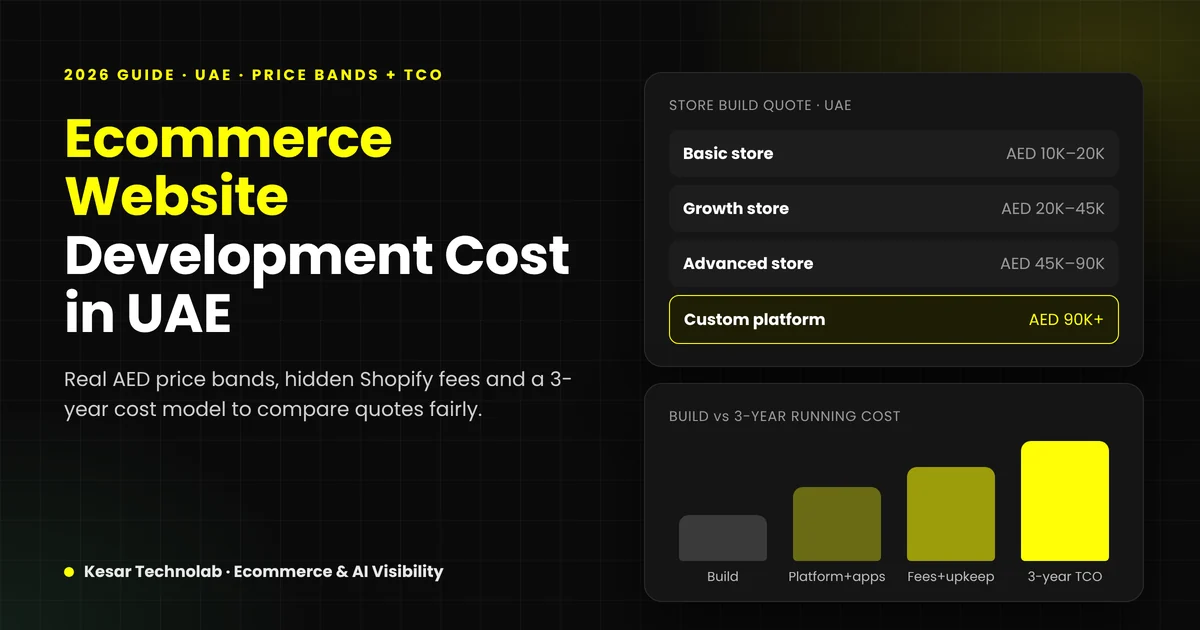
Quick answer: Published 2026 pricing from Dubai agencies puts ecommerce website development cost in the UAE at roughly AED 10,000–20,000 for a basic store, AED 20,000–45,000 for a growth store, AED 45,000–90,000 for an advanced build and AED 90,000+ for a custom platform. The build is usually the smaller part of your bill. Platform plans, apps, payment fees and maintenance over three years often cost more.
If you are budgeting for a new online store in Dubai, Abu Dhabi or Sharjah, you have probably received quotes that differ by a factor of five for what sounds like the same project. This guide explains why. It breaks down the ecommerce website development cost in UAE by tier, platform and integration. It also shows the fees that rarely appear in a quote, and gives you a simple three-year total cost of ownership (TCO) model you can use to compare proposals fairly.
It is written for founders, ecommerce managers and marketing heads at UAE retailers, D2C brands and B2B distributors who are about to choose a development partner and want to avoid paying twice.
Ecommerce Website Development Cost in UAE at a Glance
The ranges below come from published 2026 Dubai agency pricing guides. They are a market reference, not a quote. Your number depends on the drivers explained in the next section.
| Store tier | What you typically get | Published UAE range (AED) | Typical timeline |
|---|---|---|---|
| Basic store | Premium theme, up to ~100 products, standard checkout, one payment gateway, English only | 10,000–20,000 | 3–6 weeks |
| Growth store | Custom design system, Arabic + English, BNPL (Tabby/Tamara), shipping integration, analytics and SEO setup | 20,000–45,000 | 6–10 weeks |
| Advanced store | ERP/POS sync, B2B pricing, multi-currency, complex variants, custom apps | 45,000–90,000 | 10–16 weeks |
| Custom / headless platform | Bespoke front end, custom checkout logic, marketplace or subscription features | 90,000–180,000+ | 4–6+ months |
Source for ranges: Cubix’s 2026 Dubai ecommerce cost guide. Timelines are typical for a focused team and assume content and approvals arrive on time.
What Actually Drives the Price of a UAE Ecommerce Website?
Two stores with the same number of pages can differ wildly in cost. These seven drivers explain most of the variation in ecommerce website development cost in UAE projects.
1. Platform choice
Shopify, WooCommerce and custom builds have very different cost curves. Shopify lowers build and hosting effort but adds monthly plan fees, app subscriptions and, in some cases, transaction surcharges. WooCommerce has no licence fee but needs managed hosting, security and update work. Custom builds give total control and carry the highest build and maintenance cost.
2. Catalogue size and product complexity
The number of products matters less than how complex they are. A store with 2,000 simple SKUs can be cheaper to build than one with 150 products that each have size, colour, engraving and bundle options. Every extra variant rule adds design, development and testing time.
3. Template versus custom design
A well-chosen premium theme with brand styling is the fastest route to launch. A custom design system (unique layouts, components and interaction patterns) adds design and front-end hours, but it can lift conversion rate and brand recall when it is based on real customer research.
4. Arabic and right-to-left (RTL) support
A bilingual store is not a translation job. RTL layouts mirror navigation, icons, carousels, price formatting and forms. Each template needs testing in both directions. Budget for professional Arabic copy too, because machine-translated product pages hurt both trust and Arabic search visibility. Selling in Saudi Arabia as well? Compare Salla vs Zid vs Shopify for Saudi stores before you choose a platform.
5. Integrations
Integrations are where quotes diverge most. Typical UAE integrations include payment gateways (for example Telr, Network International, Checkout.com or Stripe), buy-now-pay-later (Tabby, Tamara), couriers (Aramex and local last-mile partners), cash on delivery, ERP or accounting software, and POS for omnichannel retailers. Each one needs mapping, error handling and testing.
6. B2B and wholesale features
Trade pricing, quote requests, credit terms, minimum order quantities and customer-specific catalogues turn a standard store into a B2B portal. These features also bring tax-invoice and e-invoicing requirements, covered below.
7. Content, photography and data migration
Product photography, copywriting and migrating products, customers and orders from an old platform are often excluded from quotes. If you are replatforming, 301 redirects from old URLs are non-negotiable if you want to keep your search traffic.
Not sure which tier your store falls into?
Send us your product count, required integrations and launch date. We will map your project to a tier and give you a fixed-scope estimate, with no obligation.
Shopify vs WooCommerce vs Custom: Cost Comparison for UAE Businesses
Platform choice affects your build cost once, but it affects your running cost every month. This comparison focuses on what changes the money.
| Factor | Shopify | WooCommerce | Custom / headless |
|---|---|---|---|
| Platform licence | Monthly plan: Basic USD 39, Grow USD 105, Advanced USD 399 (monthly billing); Plus from USD 2,300 | Free plugin | None, but you own all code |
| Hosting and security | Included | Managed hosting, backups, security monitoring needed | Cloud hosting and DevOps needed |
| Payment situation in UAE | Shopify Payments available on Plus and, since August 2026, Advanced. Other plans use a third-party gateway plus a Shopify surcharge | Any gateway plugin, no platform surcharge | Any gateway, custom integration |
| Third-party gateway surcharge | 2% (Basic), 1% (Grow), 0.6% (Advanced), 0.2% (Plus) | None | None |
| Arabic / RTL | Supported via theme and translation setup; quality depends on theme | Supported; quality depends on theme and plugins | Fully controllable |
| Best fit | Fast launch, lean teams, D2C brands | Content-heavy stores, full ownership, budget control | Unique business models, high scale, complex logic |
Check current figures on Shopify’s pricing page and the Shopify changelog on UAE payments before you sign. Fees and availability change.
Expert insight: the Shopify Basic surcharge trap. On Shopify Basic with a third-party UAE gateway, the 2% surcharge applies to every order, on top of your gateway’s own fee. Moving to Grow costs about USD 66 more per month (about AED 2,900 a year at the 3.6725 peg) and halves the surcharge to 1%. That makes Grow cheaper than Basic once your online sales pass roughly AED 290,000 a year. With annual billing the break-even falls to around AED 220,000. Run this calculation before you pick a plan, because few quotes include it.
The 3-Year Total Cost of Ownership (TCO) Model
Comparing build quotes alone is one of the easiest budgeting mistakes to make. A cheaper build on a platform with higher running costs can cost more by year two. Use this formula to compare proposals:
3-year TCO = Build + (Platform plan × 36) + (Apps and plugins × 36) + (Hosting and security × 36) + (Payment surcharge % × projected sales) + Maintenance retainer + Planned upgrades
The table below is an illustrative example for a mid-sized Shopify Grow store with AED 1,000,000 projected annual online sales on a third-party gateway. The numbers are assumptions to show the method, not a quote.
| Cost line (illustrative) | Year 1 | Years 2–3 | 3-year total |
|---|---|---|---|
| Build (growth tier) | AED 35,000 | – | AED 35,000 |
| Shopify Grow plan (USD 105/month) | AED 4,627 | AED 9,254 | AED 13,881 |
| Apps (assumed AED 600/month) | AED 7,200 | AED 14,400 | AED 21,600 |
| Shopify surcharge at 1% of AED 1M/year | AED 10,000 | AED 20,000 | AED 30,000 |
| Maintenance retainer (assumed AED 1,500/month) | AED 18,000 | AED 36,000 | AED 54,000 |
| Total | AED 74,827 | AED 79,654 | AED 154,481 |
In this example the build is under a quarter of the three-year cost. Gateway processing fees are excluded because they apply on every platform. The point is not the exact numbers. Once you add running costs, the cheapest build quote is often not the cheapest store.
Local Dubai Agency vs Offshore Team: What Really Changes the Cost?
Many UAE businesses compare a Dubai agency with an offshore team, often in India, to reduce cost. The decision is more nuanced than day rates.
| What changes | What does not change |
|---|---|
| Design and development hours usually cost less offshore | Shopify plan fees, app subscriptions and payment surcharges are identical wherever your developer sits |
| Larger teams can work in parallel, which can shorten timelines | Your content, photography and approval speed still set the pace |
| India is only 1.5 hours ahead of UAE time, so working days overlap almost fully | You still need one accountable project owner on your side |
The real risks with any remote team are unclear scope, weak communication and unclear IP ownership. Before you sign, confirm:
- A written scope with acceptance criteria for every feature
- Code, design files, domain and platform accounts owned by your company from day one
- A named project lead and fixed weekly check-ins in UAE business hours
- Staging environment access so you can review progress before launch
- A post-launch support period with defined response times
UAE-Specific Requirements That Affect Scope and Budget
VAT and tax invoices
UAE VAT is 5%. Your store must show VAT-inclusive pricing correctly and generate compliant tax invoices, especially for B2B orders.
E-invoicing (important for B2B stores)
The UAE is rolling out mandatory e-invoicing through accredited service providers (ASPs). Published guidance sets a voluntary pilot from 1 July 2026. Businesses with annual revenue of AED 50 million or more must comply from 1 January 2027 and appoint an ASP by 31 October 2026. Smaller businesses follow from 1 July 2027. Business-to-consumer invoices are currently out of scope, so most D2C stores are not directly affected yet. B2B and wholesale stores should plan the integration now. See the UAE Ministry of Finance e-invoicing guidelines.
Personal data protection
The UAE’s Federal Decree-Law No. 45 of 2021 on personal data protection affects how you collect consent, store customer data and work with third-party apps. A clear privacy policy, consent handling and app review should be part of scope. The government’s data protection overview is a useful starting point. Ask your legal adviser about obligations specific to your business.
Licensing, cash on delivery and logistics
You need the right trade or e-commerce licence for your emirate and activity. Cash on delivery is still common in the UAE, so plan COD rules, fees and courier reconciliation in your build.
Hidden Costs Most UAE Ecommerce Quotes Leave Out
Use this checklist when you compare proposals. If a line is missing, ask who pays for it.
- Premium theme licence and renewal
- Paid apps or plugins (reviews, search, subscriptions, loyalty, translation)
- Arabic copywriting and RTL quality assurance
- Product data entry, photography and image optimisation
- Data migration and 301 redirect mapping
- Payment gateway setup fees and Shopify surcharges
- Email and SMS tools for abandoned carts and order updates
- Analytics, conversion tracking and consent mode setup
- Technical SEO and product schema
- Maintenance, security updates and backups after launch
Have a quote already? Get a second opinion.
Share the proposal you received. We will flag missing line items, risky assumptions and running costs that are not included, so you can compare like for like.
How to Get an Accurate Ecommerce Website Quote in the UAE: The 10-Point Brief
The quality of a quote depends on the quality of the brief. Send every agency the same information so the quotes are comparable:
- Business model: D2C, B2B, marketplace or a mix
- Number of products and how complex the variants are
- Languages and markets (UAE only, GCC or international)
- Preferred platform, or a request for a recommendation
- Required payments, BNPL, COD and couriers
- Systems to integrate: ERP, POS, CRM, accounting
- Design expectation: premium theme or custom design system
- Content readiness: copy, photography, product data
- Target launch date and any fixed campaign dates
- Budget range, including expected monthly running costs
Sharing a budget range is not a weakness. It lets a good agency recommend the right tier instead of guessing.
How Long Does It Take to Build an Ecommerce Website in the UAE?
| Phase | What happens | Typical duration |
|---|---|---|
| Discovery and scope | Requirements, integrations, sitemap, acceptance criteria | 1–2 weeks |
| UX and UI design | Wireframes, design system, English and Arabic layouts | 2–4 weeks |
| Development and integrations | Theme or custom build, payments, shipping, ERP | 3–8 weeks |
| Content and data | Product import, copy, images, redirects | Runs in parallel |
| QA and launch | Device, RTL, checkout and payment testing; go-live | 1–2 weeks |
Why “AI-Ready” Belongs in Your 2026 Ecommerce Scope
Buyers increasingly ask ChatGPT, Gemini, Perplexity and Google’s AI Overviews which products or stores to consider. These systems rely on content they can crawl and understand. An ecommerce build in 2026 should include, at minimum:
- Product structured data (price, availability, reviews where genuine) following Google’s product structured data documentation
- Product pages rendered in crawlable HTML, not only through JavaScript
- Clear, factual product descriptions with specifications, materials, sizing and delivery terms
- FAQ and comparison content that answers real pre-purchase questions
- Clean category architecture and internal linking
If you also sell to consumers in the EU, add the accessibility requirements if you sell into the EU to your scope as well. Adding these during the build costs far less than retrofitting them later. Our guide to getting products recommended by ChatGPT, Perplexity and Gemini explains the approach in detail.
Example scenario (illustrative, not a client case): A Dubai-based fashion brand with 300 products, Arabic and English, Tabby, Aramex and cash on delivery receives three quotes: AED 12,000, AED 32,000 and AED 70,000. The AED 12,000 quote excludes Arabic, BNPL and data migration. The AED 70,000 quote includes a custom headless front end the brand does not need yet. The AED 32,000 growth-tier quote matches the scope, but it runs on Shopify Basic with a third-party gateway. At the brand’s projected sales, switching that quote to Grow lowers the three-year cost. Ask the questions in this guide and the “cheapest” quote often turns out to be the most expensive.
Key Takeaways
- Ecommerce website development cost in UAE ranges from about AED 10,000 for a basic store to AED 90,000+ for custom platforms, based on published 2026 agency pricing.
- The build is usually a minority of three-year cost. Compare proposals on TCO, not build price.
- On Shopify, check whether Shopify Payments is available on your plan in the UAE. If not, factor in the third-party surcharge.
- Arabic RTL, integrations and B2B features are the biggest swing factors in scope.
- B2B stores should plan for UAE e-invoicing now. B2C invoices are currently out of scope.
- Build for AI search from day one with structured data, crawlable product pages and clear product facts.
How Kesar Technolab Can Help
Kesar Technolab designs and builds conversion-focused ecommerce stores on Shopify, WooCommerce and custom stacks for brands in the UAE and across the GCC. Every build includes technical SEO, schema markup and Core Web Vitals work, so your store can be found in Google and cited by AI assistants. Our web and app development team handles the build. Our e-commerce growth services cover what happens after launch: SEO, performance marketing and conversion optimisation.
Because our team is based in India, UAE clients get senior design and development with almost full working-day overlap and a single point of contact.
What you can hold us to:
- A written scope with acceptance criteria before any work starts
- Your company owns the code, design files, domain and platform accounts from day one
- Staging access throughout the build, so you see progress every week
- Direct access to a senior lead, with no hand-offs to junior teams
- 30 days of post-launch support included
- A three-year running-cost estimate alongside every quote
Ready to Discuss Your Project?
Tell us about your products, markets and integrations. We will reply with a recommended platform, a scoped estimate and a three-year cost view, so you know what the store will really cost before you commit.
Get your UAE ecommerce estimate with a 3-year cost view
Fixed scope. Clear running costs. No obligation.
Frequently Asked Questions
How much does an ecommerce website cost in Dubai?
Published 2026 Dubai agency guides list about AED 10,000–20,000 for a basic store, AED 20,000–45,000 for a growth store, AED 45,000–90,000 for advanced builds and AED 90,000+ for custom platforms. Arabic support, integrations and B2B features move projects between tiers.
Is Shopify or WooCommerce cheaper in the UAE?
WooCommerce has no licence fee or platform surcharge but needs hosting, security and updates. Shopify includes hosting but charges a monthly plan and, if you use a third-party gateway, a surcharge of 0.2–2% depending on plan. Compare them on a three-year TCO, not on build price alone.
Is Shopify Payments available in the UAE?
Shopify Payments was available in the UAE on the Plus plan and, according to Shopify’s August 2026 changelog, is now also available on the Advanced plan. Merchants on other plans use third-party gateways and pay a Shopify transaction surcharge. Check Shopify’s current documentation before choosing a plan.
How long does it take to build an ecommerce website in the UAE?
A basic store typically takes 3–6 weeks, a growth store 6–10 weeks and an advanced store 10–16 weeks. Custom platforms can take four to six months or more. Content readiness and approval speed are the most common causes of delay.
What monthly costs should I expect after launch?
Expect platform or hosting fees, app subscriptions, payment fees and a maintenance or support retainer. Many brands also budget for SEO and performance marketing. Running costs over three years often exceed the original build cost.
Do I need an Arabic version of my online store?
Not always, but it usually widens your audience in the UAE and is close to essential for the wider GCC. A proper Arabic version needs RTL layouts and professional copy, not just machine translation.
Does UAE e-invoicing apply to my online store?
Under current guidance, business-to-consumer invoices are out of scope, so most D2C stores are not directly affected yet. B2B stores and wholesalers are in scope. Large businesses must comply from January 2027 and smaller ones from July 2027.
Is it safe to outsource ecommerce development from the UAE to India?
It can be, if the contract protects you. Insist on written scope and acceptance criteria, company ownership of code and accounts, a named project lead, staging access and a defined support period. India’s 1.5-hour time difference with the UAE makes day-to-day collaboration practical.
What payment gateways can a UAE ecommerce website use?
Common options include Telr, Network International, Checkout.com and Stripe, plus buy-now-pay-later providers such as Tabby and Tamara. Which ones you choose affects integration effort, fees and, on Shopify, whether a surcharge applies.
How do I make my ecommerce store visible in ChatGPT and AI search?
Use crawlable product pages, accurate product structured data, clear product facts and helpful pre-purchase content. AI assistants can only recommend what they can find and understand, so build these into your store from the start.