Best AI Visibility Tools in 2026: Profound vs Peec AI vs Semrush vs Otterly (Prices Compared)
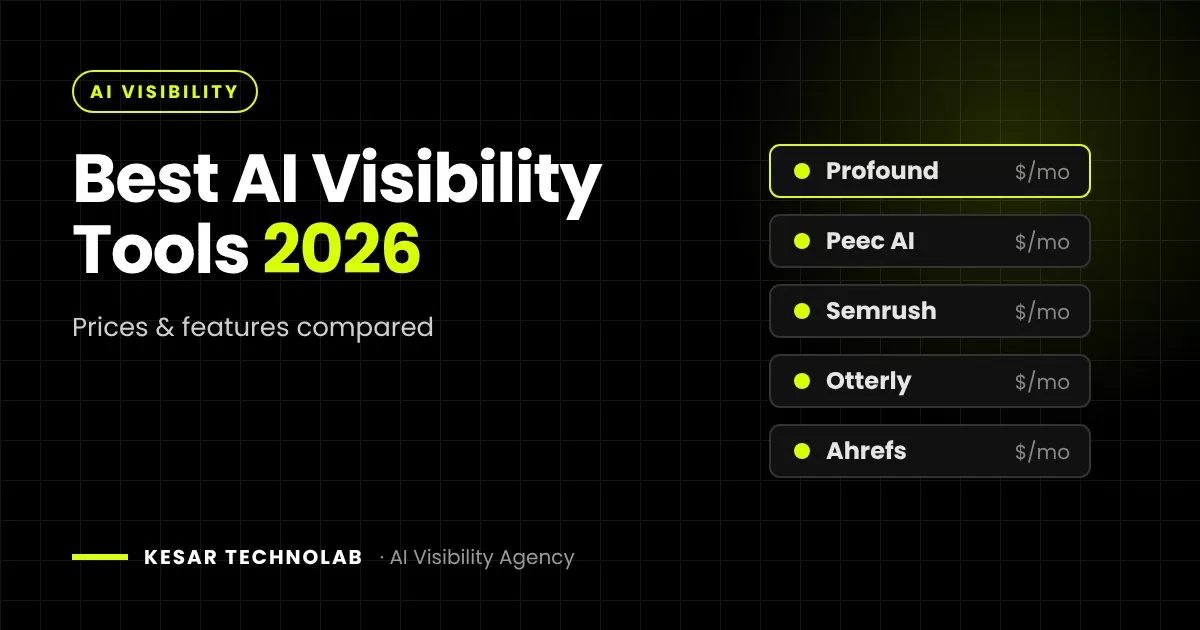
Short answer: The best AI visibility tools in 2026 are Otterly.AI (cheapest entry at $29 a month), Peec AI (best value for growing teams), Semrush AI Visibility Toolkit (best if you already use Semrush), Profound (best for enterprise and deep analytics), and Ahrefs Brand Radar (best for large-scale brand-mention research). All of them measure how often ChatGPT, Gemini, Perplexity and Google AI Overviews mention you. None of them fixes anything. Below are verified prices, a side-by-side comparison, and a simple test for when a tool is enough and when you need an agency.
What AI visibility tools actually do
An AI visibility tool (also called an AI search visibility tracker, LLM tracking tool or GEO tool) runs a list of prompts through AI engines on a schedule and records:
- Mentions: whether your brand is named in the answer, and in what position
- Citations: whether your URL is linked as a source
- Share of voice: your mentions compared with competitors’
- Sentiment: how the AI describes you
- Source domains: which websites the AI relied on for its answer
Think of it as rank tracking for AI answers. Like rank tracking, it tells you where you stand, not how to move.
AI visibility tools compared: prices and coverage (October 2026)
| Tool | Entry price (monthly) | Higher tiers | Prompts at entry | AI engines | Best for |
|---|---|---|---|---|---|
| Otterly.AI | $29 (Lite) | $189 Standard, $489 Premium | 15 | ChatGPT, AI Overviews, Perplexity, Copilot; Gemini, AI Mode and Claude as paid add-ons | Solo founders and first baselines |
| Peec AI | $95 (Starter) | $245 Pro, $495 Advanced | 50 | Choose 3 of: ChatGPT, AI Mode, AI Overviews, Copilot, Gemini, Naver AI (more on Enterprise) | Startups and in-house teams; unlimited seats |
| Semrush AI Visibility Toolkit | $99 per domain | Add-ons $10–$90 | Varies | ChatGPT, Google AI Mode (others vary by plan) | Teams already on Semrush who want prompt research plus an AI site audit |
| Profound | $99 (Starter, annual) | $399 Growth; custom Enterprise | 50 (ChatGPT only) | Up to 9 on Enterprise, incl. ChatGPT, Perplexity, AI Mode, Gemini, Copilot, Claude | Enterprise brands that need deep analytics and SSO |
| Ahrefs Brand Radar | From $199 | $398 (selected platforms) – $699 (all) | Large index rather than custom prompts | Multiple AI platforms | Category-level market research and competitor share |
| Scrunch | $300 (Starter) | $500 Growth | Varies | Multiple | Mid-market teams that need several seats |
| AthenaHQ | Free tier (300 credits) | $295 Starter | Credit-based | 5 models free, 9 on Starter | Testing before you commit |
Annual billing is usually about 15% cheaper. Otterly and Semrush prices were checked on vendor pages on October 14, 2026. Peec AI, Profound, Scrunch, AthenaHQ and Ahrefs Brand Radar figures come from an August 2026 roundup of published prices, because several vendors now hide prices behind demos. Confirm at checkout.
Tool-by-tool verdicts
Otterly.AI: best budget AI visibility tool
Pros: the lowest entry price, simple setup, and it covers the four engines most buyers use by default. Cons: 15 prompts on Lite is too few for a real baseline, and Gemini and Claude cost extra. Choose it if you want to start tracking this week for under $50.
Peec AI: best value for startups and SMBs
Pros: 50 prompts at entry, unlimited users, clean competitor and source reporting. Cons: you pick only 3 engines per plan, and pricing is no longer shown publicly. Choose it if you run a weekly marketing review and want the whole team in the dashboard.
Semrush AI Visibility Toolkit: best for existing Semrush users
Pros: sits next to your SEO data, adds AI prompt research (topic volume, difficulty, intent) and an AI search site audit that flags crawler issues. Cons: billed per domain and per user, so costs climb for agencies and multi-brand companies. Choose it if Semrush is already your SEO home base.
Profound: best for enterprise
Pros: the widest engine coverage, ChatGPT Shopping data, agent analytics, API, SSO and SOC 2. Cons: the entry tier covers ChatGPT only, and the real capability sits in custom enterprise pricing. Choose it if you are a large brand with a dedicated AI search owner.
Ahrefs Brand Radar: best for market-level research
Pros: a huge pre-built query index, so you can see category share of voice without writing prompts. Cons: confusing price points ($199 vs $398 vs $699), and it is less suited to tracking a fixed set of your own buyer prompts. Choose it if you want to size a category or benchmark competitors at scale.
How to choose an AI visibility tool: 8 criteria
- Engine coverage: does it track the engines your buyers use? B2B buyers lean on ChatGPT and Copilot; consumers lean on Google AI Overviews and Gemini.
- Prompt volume: you need 30–50 prompts per market for a meaningful baseline.
- Run frequency: daily is better than weekly, because AI answers vary from run to run.
- Region and language: can it run prompts as a US, UK, Australian or UAE user?
- Source/citation data: does it show which domains the AI cited? This is where your action plan comes from.
- Competitor tracking: share of voice against at least 3–5 named competitors.
- Exports and API: CSV or API access, so you can join the data with GA4 and your CRM.
- Seats and workspaces: unlimited seats (Peec) vs per-user pricing (Semrush) changes the real cost a lot.
The limitations nobody puts on the pricing page
- AI answers are non-deterministic. The same prompt can name you in one run and not the next. Read trends over weeks, not single snapshots.
- Your prompt list biases your results. If you write prompts that already favour you, the dashboard will look great while real buyers never see you.
- “Prompt volume” is modelled, not measured. No AI company publishes query volumes the way Google Keyword Planner does, so treat volume figures as directional.
- Logged-in users see different answers. Memory and personalisation mean your buyers’ results will differ from the tool’s clean-session results.
- Measurement is not improvement. A tool will show a 4% share of voice. It will not rewrite your pricing page, fix your schema or get you onto the listicles AI engines cite.
The free alternative: a DIY tracking sheet
Before paying for anything, you can build a baseline in a spreadsheet: 30 prompts, 3 engines, 3 runs each, logging mention, position, cited URLs and competitors named. It takes about a day. Our AI visibility audit checklist gives you the exact columns and a 100-point scorecard. Buy a tool once you need to repeat the run every week.
AI visibility tool vs AI visibility agency: which do you need?
| A tool is enough if… | You need an agency (or a skilled in-house team) if… |
|---|---|
| You already appear in AI answers and just need to monitor them | You are rarely or never mentioned for your category prompts |
| You have a marketer with time to act on the data each week | Nobody owns the fixes: schema, content rewrites, outreach, review profiles |
| Your site is technically sound and AI crawlers can access it | AI crawlers are blocked, your content needs JavaScript to render, or entity data is messy |
| Budget is under $500 a month | AI search is becoming a real lead channel and competitors are already investing |
For the cost side of that decision, see what AI visibility agencies charge in 2026 and AEO agency vs SEO agency.
How Kesar Technolab uses these tools for clients
We are tool-agnostic. We pick the tracker that fits your engines, markets and budget, and we show tool costs as a separate line in every quote. The tool provides the baseline; our work is the part tools do not do: fixing crawl access, building AI-readable structure and schema, rewriting pages into answer-first formats, and earning mentions on the domains AI engines actually cite. See our AI visibility optimization service.
Not sure which tool to buy, or whether you need one yet? We will run your first baseline for free, across ChatGPT, Gemini, Perplexity and AI Overviews, and recommend the cheapest tool that fits.
Or call +91 63531 74560.
FAQ: AI visibility tools
What is the best AI visibility tool in 2026?
For most startups and SMBs, Peec AI or Otterly.AI give the best value. Semrush’s AI Visibility Toolkit is the natural choice if you already use Semrush, and Profound suits enterprises that need deep analytics, API access and SSO.
How much do AI visibility tools cost?
Entry plans range from about $29 a month (Otterly.AI Lite) to around $99 (Semrush, Profound Starter, Peec AI Starter at about $95). Mid-tier plans run $189–$500 a month. Enterprise plans are custom.
Is there a free AI visibility tool?
AthenaHQ has a free credit-based tier, and Profound offers a free 7-day trial. You can also track manually for free with a spreadsheet and logged-out sessions in ChatGPT, Gemini and Perplexity.
Can AI visibility tools track Google AI Overviews?
Yes. Otterly.AI, Peec AI, Profound and others track Google AI Overviews, and several also track Google AI Mode. Check plan details, because some engines are paid add-ons.
Do AI visibility tools improve my rankings in ChatGPT?
No. They measure visibility. Improvement comes from technical access, clear entity data, answer-first content and third-party citations. Some tools suggest fixes, but someone still has to implement them.
How many prompts should I track?
Start with 30–50 prompts per market, split across category discovery, comparisons, use cases, pricing and brand questions. Fewer than 20 prompts rarely gives a reliable picture.
Where to read next
- AI visibility audit: the 2026 checklist
- AI visibility agency pricing in 2026
- Agentic AI search in 2026
- AI visibility for e-commerce
Sources: Otterly.AI pricing; Semrush AI Toolkit knowledge base; Peec AI pricing; Profound pricing; Ryze, AI visibility tool pricing compared (August 29, 2026). Prices change often; last reviewed October 14, 2026.