Kesar Technolab | AI Visibility Agency

Short answer
AI visibility for ecommerce is not one lever, it is three. There are three ways a product gets recommended by an AI assistant: a merchant product feed submitted directly to the platform, your product pages being crawled and understood (schema.org/Product is the vocabulary they read), and third-party reviews and comparisons that corroborate your product. The third is the strongest and the one most merchants ignore entirely. Feeds get you eligible; reviews get you chosen.
Why AI shopping is not just Google Shopping with a chat interface
In Google Shopping, a buyer sees a grid. Twenty products, prices, thumbnails, and the buyer does the comparing. Your job was to be in the grid and be competitively priced.
In an AI assistant, the buyer asks "what's the best insulated water bottle for a 12-hour shift under ₹2,000?" and receives two or three named products with reasoning. There is no grid. There is no page two. Either you are in the shortlist or you do not exist for that query.
This changes the economics in a specific way: the number of products that can be surfaced per query collapses, while the qualification of each buyer who does see you rises sharply. Semrush's 2025 analysis found AI search visitors worth roughly 4.4x more than traditional organic visitors, and Seer Interactive measured ChatGPT referral conversion at 15.9% against 1.76% for Google organic. Fewer impressions, dramatically better intent — because the assistant has already done the filtering the buyer would otherwise have done across six tabs.
One caveat worth stating, since most articles on this topic leave it out: BrightEdge's 2026 data showed AI Overview coverage on e-commerce queries actually fell to around 4% from 29% in 2024, as Google pulled back on generative answers for transactional searches. So the opportunity is real but it is not uniform — it is concentrated in research and comparison prompts ("best", "vs", "for [use case]", "alternatives to") rather than in bottom-of-funnel product-name searches. Plan accordingly.
The three doors into AI product recommendations
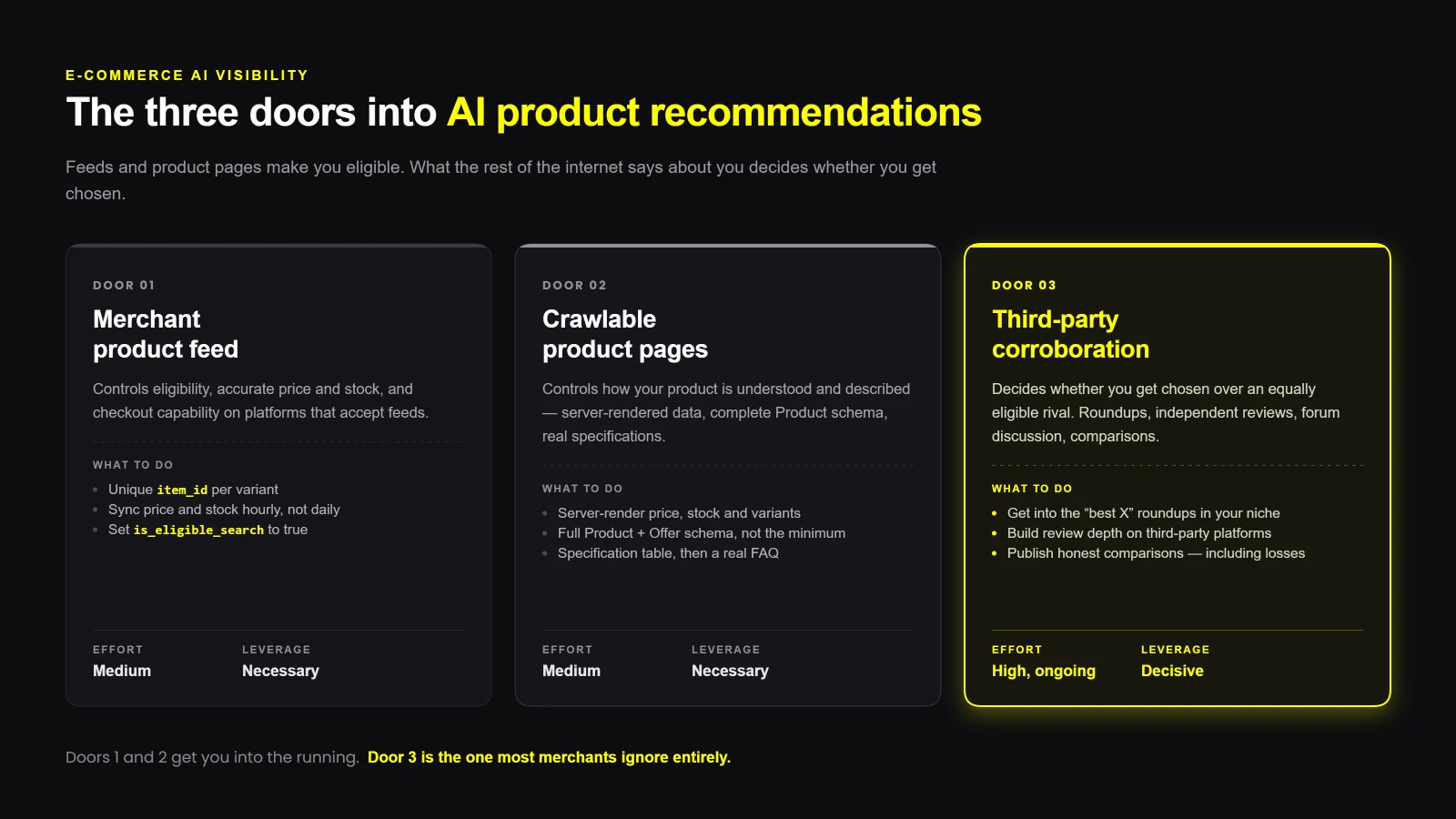
| Door | What it controls | Effort | Leverage |
|---|---|---|---|
| 1. Merchant product feed | Eligibility, accurate price and stock, checkout capability | Medium — one-time build, ongoing sync | Necessary |
| 2. Crawlable product pages | How your product is understood and described | Medium | Necessary |
| 3. Third-party corroboration | Whether you get chosen over an equally eligible rival | High — ongoing | Decisive |
Door 1: The ChatGPT product feed and agentic checkout
On 29 September 2025, OpenAI launched Instant Checkout — buying inside ChatGPT — alongside the Agentic Commerce Protocol (ACP), an open standard co-developed with Stripe. It launched with US Etsy sellers, with Shopify merchants following.
Two things matter for merchants. First, OpenAI publishes a formal product feed specification. Second, OpenAI has stated that product results are ranked on relevance to the query — considering availability, price, quality, and whether the merchant is the primary seller — and that Instant Checkout items are not preferred in product results. Merchants pay a small fee on completed purchases; pricing to the shopper is unaffected.
Read that carefully, because it is the opposite of the assumption most merchants make. Enabling checkout does not buy you placement. Being the right answer does.
The required feed fields

OpenAI's spec sets out the required fields for a non-ads feed. Getting these wrong is the most common reason a catalogue fails ingestion:
| Field | Format / limit | Where merchants go wrong |
|---|---|---|
item_id | String, ≤100 chars, unique per variant | Reusing one ID across sizes and colours |
title | String, ≤150 chars | Keyword-stuffed titles that read as spam to a model |
description | String, ≤5,000 chars | 40 words of marketing fluff. The single biggest miss — see below |
url | Product detail page URL | Pointing to a category page or a redirect chain |
brand | String, ≤70 chars | Inconsistent spellings across the catalogue |
image_url | Main product image | Lifestyle shots where the product is ambiguous |
price | Number + ISO 4217 currency | Stale prices — a mismatch against the live page destroys trust instantly |
availability | in_stock / out_of_stock / pre_order / backorder / unknown | Daily syncs on fast-moving inventory |
seller_name, seller_url | String ≤70 chars, URL | Name that does not match the brand entity elsewhere |
target_countries, store_country | ISO 3166-1 alpha-2 | Omitting these, then wondering why you never surface |
is_eligible_search, is_eligible_checkout | Boolean | Leaving search eligibility false by default |
If checkout is enabled you must also supply seller_privacy_policy and seller_tos. Recommended-but-high-value additions include gtin or mpn, size and size_system for apparel, group_id with listing_has_variations, return_policy, and — importantly — q_and_a and reviews. Feeds can be delivered by SFTP, direct file upload, or a hosted URL.
The 5,000-character description field is the most underused asset in AI commerce. Google Shopping trained a generation of merchants to write short, keyword-dense titles and thin descriptions. An AI assistant matching "best bottle for a 12-hour shift" needs to know the insulation duration, the capacity, the weight, whether it fits a car cup holder, and whether it is dishwasher safe. Those specifics are what let a model match your product to an unusual query. Fluff cannot be matched against anything.
Door 2: Product pages an AI can actually read
Feeds cover the platforms that accept feeds. Assistants also read the open web — and for research-stage prompts, that is often all they read. Everything in our guide to what makes a site AI-readable applies here, with three e-commerce specifics.
Server-render your product data
Headless storefronts frequently load price, stock and variant data client-side. AI crawlers are weaker at JavaScript execution than Googlebot. If view-source: on your product page does not contain the price, a meaningful share of crawlers see a product with no price — and a product with no price does not get recommended in a budget-constrained query. If your storefront is headless, our web and app development team can move price, stock and variants into the server-rendered HTML.
Complete Product schema
Use Product with Offer, and populate more than the minimum: name, brand, sku, gtin13, description, image (several), offers with price, priceCurrency, availability, priceValidUntil, shippingDetails and hasMerchantReturnPolicy, plus aggregateRating and review where you have genuine reviews. Add additionalProperty entries for the specifications that matter in your category — this is how attributes become machine-comparable.
The rule from traditional SEO holds absolutely: schema must reflect what a human can see on the page. Invented ratings are a trust problem, not a shortcut.
Write the specifications a buyer would ask about
Most product pages answer "why this brand is great". AI-recommended product pages answer "does this fit my situation". A short table of concrete attributes — dimensions, materials, compatibility, capacity, power draw, care instructions, what is in the box, who it is not suitable for — outperforms any amount of persuasion copy, because each row is a matchable fact.
Include a genuine FAQ on the PDP answering the questions your support team gets, marked up with FAQPage. "Does it fit a standard cup holder?" is exactly the kind of specific constraint that decides an AI recommendation.
Door 3: The one that actually decides it
Two merchants, identical feeds, identical schema, comparable prices. One gets recommended consistently. The difference is almost always what the rest of the internet says.
Assistants are built to hedge against being wrong, so they lean on independent corroboration. SE Ranking's November 2025 analysis found sites referenced across more than 32,000 domains were around 3.5x more likely to be cited by ChatGPT. For products, corroboration means:
- Being in the "best X" roundups. When someone asks for the best product in your category, the model frequently retrieves the listicles that already answer that question. If you are not in them, you are not in the answer. Getting reviewed by the publications and creators in your niche is the highest-return AI commerce activity there is, and it is a PR job rather than a technical one.
- Review volume and recency on third-party platforms. Not just your own site. Marketplace listings, Trustpilot, category-specific review sites, YouTube reviews with transcripts.
- Reddit and forum presence. Real practitioner discussion in your category is heavily retrieved. This cannot be faked — astroturfing is detectable, gets removed, and burns the brand.
- Marketplace listings as corroboration. An Amazon or Flipkart listing with hundreds of reviews is an independent quality signal even when you would rather sell direct.
- Comparison content, including against yourself. A page comparing your product honestly to the two main alternatives — including where you lose — is disproportionately cited, because it is the content shape the model is looking for.
This is the same mechanism described in agentic AI search in 2026, applied to a catalogue instead of a services business.
What an AI agent evaluates when it picks a product
Combining OpenAI's stated ranking considerations with observed behaviour across assistants, the practical checklist is:
- Constraint match. Does the product satisfy every stated constraint — budget, size, use case, timeline? A model will drop a better product that misses a stated constraint. This rewards specification detail over persuasion.
- Availability. Out of stock is effectively invisible. Feed freshness is a ranking factor in disguise.
- Price accuracy. A price in the answer that does not match the landing page is a failure the platform will avoid repeating.
- Quality signals. Ratings and review depth, weighted by independence.
- Primary-seller status. OpenAI names this explicitly. Being the brand rather than a reseller helps.
- Corroboration breadth. How many independent sources describe the product consistently.
- Friction. Return policy, shipping clarity, checkout capability. Not a placement bonus, but it affects whether a recommendation is useful.
Before and after: one product description
Before (what most catalogues contain):
"Premium Stainless Steel Insulated Water Bottle — Best Quality Vacuum Flask Thermos for Office Gym Travel. Buy Now! Durable, stylish and leak-proof. Perfect gift."
After (what an assistant can match against a real query):
"750ml double-walled 18/8 stainless steel insulated bottle. Keeps liquids hot for 12 hours and cold for 24 hours in independent testing at 22°C ambient. Weighs 340g empty. Base diameter 7.3cm — fits standard car and gym cup holders. Wide 5cm mouth accepts ice cubes; leak-proof screw cap tested to 30 inversions. Body is dishwasher safe; the cap should be hand-washed. Available in 750ml and 1L, six colours. Not suitable for carbonated drinks. Ships from Ahmedabad, 2–5 day delivery across India. Two-year warranty on the vacuum seal."
The second version is longer, contains no adjectives doing persuasion work, and can be matched against "bottle that fits a cup holder", "keeps cold 24 hours", "under 400g", "wide mouth for ice", "dishwasher safe" and "not for fizzy drinks". Each concrete fact is a query it can now win. This rewrite is unglamorous, applies across the whole catalogue, and is the bulk of real e-commerce growth work in AI search.
How to measure AI visibility for ecommerce
There is no Search Console for AI shopping. What you can do:
- A fixed prompt panel. Define 20–40 buying prompts covering your categories, price bands and use cases. Run them monthly across ChatGPT, Claude, Perplexity and Gemini in logged-out sessions. Log whether you appear, which of your products, which competitors, and what is cited. This is your primary instrument.
- AI referral segments in GA4. Build a segment for referrals from chatgpt.com, perplexity.ai, claude.ai, gemini.google.com and copilot.microsoft.com. Volume will be small; conversion rate should be notably high. Judge it on revenue per session, not sessions.
- Server log filtering. Confirm
OAI-SearchBot,Claude-SearchBotandPerplexityBotare actually fetching your product pages. Zero hits means a blocking problem, not a content problem. - Self-reported attribution. Add "Where did you first hear about this product?" to post-purchase. Crude, and currently the most honest read on AI influence you can get.
- Branded search volume. Rising branded searches with flat ad spend is a plausible proxy for assistant-driven discovery.
Six mistakes that cost merchants recommendations
- Treating the feed as a Google Shopping copy-paste. Different spec, different consumer. A model reads the description; a shopping grid barely shows it.
- Infrequent inventory sync. An out-of-stock recommendation is a failure the platform learns from.
- Client-side pricing. Invisible price, no recommendation in any budget-constrained query.
- Zero third-party review presence. On-site reviews alone are self-reported. Corroboration has to come from outside.
- No comparison content. Refusing to name competitors means you are absent from the exact content type these queries retrieve.
- Assuming checkout integration equals placement. OpenAI states Instant Checkout items are not preferred in product results. Relevance decides; checkout only removes friction after you have been chosen.
A realistic 90-day sequence
Days 1–14 — unblock and baseline. Audit robots.txt for the AI search and user agents. Verify product data is in the HTML source. Run your prompt panel and record the baseline, including which competitors win.
Days 15–45 — fix the data layer. Complete Product and Offer schema across the catalogue. Rewrite descriptions for your top 20% of products by revenue, specification-first. Build or correct the platform feed and get inventory syncing at least hourly.
Days 46–90 — earn corroboration. Outreach to the reviewers and publications that own the "best X" roundups in your category. Build honest comparison pages for your top three products. Push for third-party review volume. Add PDP FAQs from real support tickets.
Ongoing. Re-run the prompt panel monthly. Expect volatility — model retrieval changes without announcements, and a month of decline is not necessarily your fault. Judge the programme on a rolling quarter, not a single reading.
Find out which of your products AI assistants already recommend
Our free AI Visibility Audit for e-commerce runs a buying-prompt panel across ChatGPT, Claude, Perplexity and Gemini for your categories, checks your feed and Product schema against the current specs, and returns the transcripts — including which competitor is being recommended in your place.
Get your free e-commerce AI audit →
Or call +91 63531 74560. Tell us your three best-selling SKUs and we will test those first.
Frequently asked questions
How do I get my products to show up in ChatGPT?
Two routes, and you want both. Submit a product feed built to OpenAI's published specification — via SFTP, file upload or a hosted URL — with all required fields including is_eligible_search set true. Separately, make sure your product pages are crawlable by OAI-SearchBot, render price and stock in the HTML source, and carry complete Product schema. The feed makes you eligible; relevance and corroboration decide whether you are recommended. For the brand-level side of ChatGPT visibility, read our ChatGPT SEO guide.
Does enabling Instant Checkout improve my ranking in ChatGPT?
No. OpenAI states that product results are ranked on relevance to the user's query and that Instant Checkout items are not preferred in product results. Checkout removes friction after a shopper has decided; it does not buy placement. Merchants pay a small fee on completed purchases and shopper pricing is unaffected.
Is Product schema enough to get recommended by AI?
No. Schema makes your product data unambiguous, which is necessary but not sufficient. In our experience the decisive factor between two equally well-marked-up products is third-party corroboration — independent reviews, "best of" roundups, forum discussion and marketplace review depth. Schema gets you understood; corroboration gets you chosen.
Which AI crawlers do e-commerce sites need to allow?
Allow OAI-SearchBot, ChatGPT-User, Claude-SearchBot, Claude-User and PerplexityBot at minimum. Blocking a search-focused agent removes your products from that platform's answers entirely — OpenAI states that sites opted out of OAI-SearchBot will not be shown in ChatGPT search answers. Training-focused crawlers are a separate decision that does not affect current visibility.
How long should a product description be for AI search?
Long enough to state every specification a buyer might constrain on — typically 150 to 400 words for a considered purchase. OpenAI's feed spec allows up to 5,000 characters. Prioritise measurable facts (dimensions, capacity, materials, compatibility, duration, weight, care, exclusions) over persuasive adjectives, because facts are what a model can match against a query.
Does AI shopping traffic actually convert?
The available data says yes, at low volume. Semrush's 2025 analysis put AI search visitors at roughly 4.4x the value of traditional organic visitors, and Seer Interactive measured ChatGPT referral conversion at 15.9% versus 1.76% for Google organic. But total AI referral traffic remains a small share of the web — Conductor put it near 1% of total traffic in late 2025 — and BrightEdge found AI Overview coverage on e-commerce queries fell to about 4% in early 2026. Treat it as a high-quality, fast-growing, still-small channel, not a replacement for paid or organic.
Should I still run Google Shopping and paid ads?
Yes. AI referral volume is nowhere near large enough to replace either. The sensible structure is performance marketing for immediate revenue, traditional SEO and Shopping for the bulk of organic demand, and AI visibility work as a compounding layer that is cheap to add once the product data is clean — because the same feed hygiene and specification detail improve all three. If Google is still your largest channel, our guide to ranking in Google AI Overviews covers the Google side of AI search.
Where to read next
- llms.txt and schema markup: what actually makes your site AI-readable — the technical layer underneath all of this.
- Agentic AI search in 2026 — how AI agents choose what to cite.
- What is AI visibility? The complete AEO and GEO guide
- AEO agency vs SEO agency — which kind of help a retailer actually needs.
- AI visibility agency pricing in 2026
- ChatGPT SEO: how to get your brand recommended by ChatGPT — the brand-level playbook that sits alongside your product feed.
- How to rank in Google AI Overviews — the Google side of AI search.
Sources referenced: OpenAI "Buy it in ChatGPT: Instant Checkout and the Agentic Commerce Protocol" (29 September 2025); OpenAI Agentic Commerce product feed specification; Semrush AI search traffic value analysis (2025); Seer Interactive AI referral conversion study (2025); BrightEdge AI Overview coverage data (February 2026, as reported); SE Ranking citation analysis (November 2025); Conductor AI referral traffic share (November 2025). Last reviewed August 2026.