
Private internal system
Rama Gum Industries
Enquiries, quotations, orders, shipments and export documents in one CRM.
Custom Software · CRM Development
Project overview
Rama Gum Industries (India) Ltd. is a certified Star Export House that has manufactured and exported guar gum, psyllium, spices and hydrocolloids since 1989. We built a custom CRM that runs its export sales cycle in one place: from the first buyer enquiry to the quotation, the order, the shipment and the export paperwork.
Client
Rama Gum Industries (India) Ltd.
Industry
Food ingredients, import & export
Users
Internal sales & export teams
Services
Custom CRM development
Website
Private system, not publicly accessible
4
Core modules in one system
1
System from enquiry to shipment
1989
Client exporting since
Screenshots aren’t shown because the CRM holds the client’s customer, pricing and shipment data.
The challenge
Why this project mattered
Export sales have many moving parts: enquiries from buyers in different countries, quotations and proforma invoices, confirmed orders, container shipments and a stack of export documents.
When all of that lives in email threads and spreadsheets, follow-ups slip and the same details get re-typed for every quotation and shipment.
What we did
Our approach
01
Leads and enquiries
One place to log buyer enquiries and track every follow-up through the sales pipeline.
02
Quotations and proforma invoices
Quotations and proforma invoices prepared inside the CRM against each enquiry, keeping pricing and buyer details in one record.
03
Orders and shipments
Confirmed orders tracked through to dispatch, with shipment status visible to the whole team.
04
Export documents
Export paperwork such as invoices and packing lists generated and stored with each order.
What We Delivered for Rama Gum
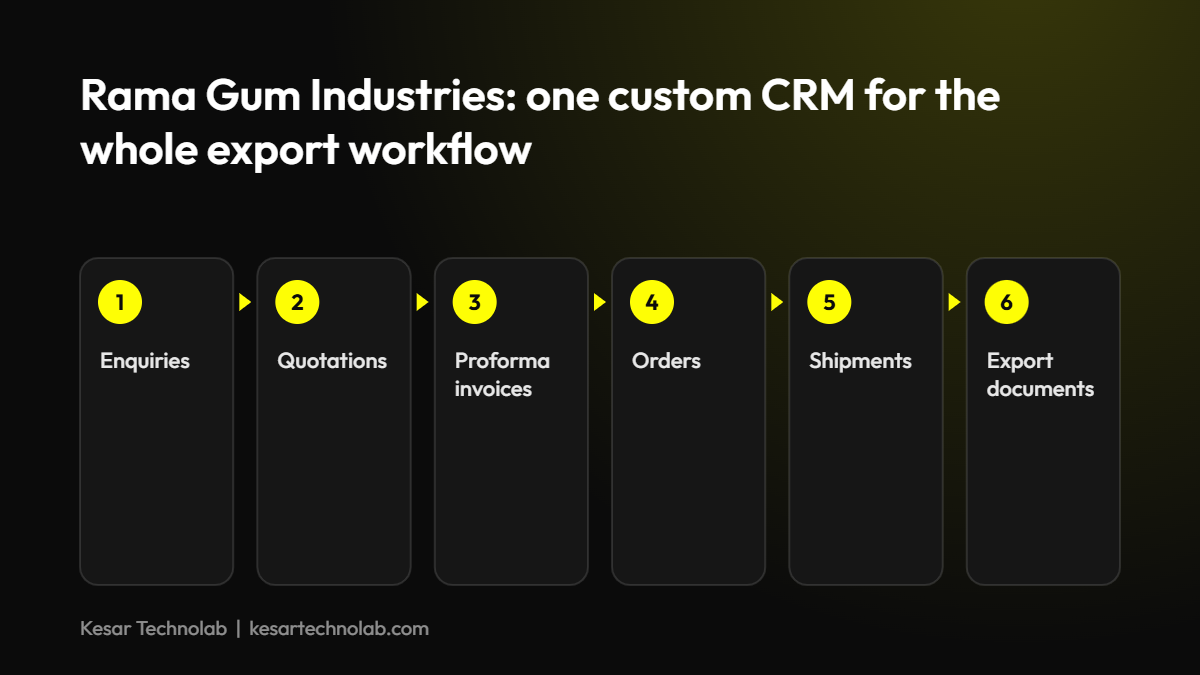
Rama Gum now runs its export sales cycle in one private system with four core modules:
- Leads and enquiries: every buyer enquiry logged and followed up through the sales pipeline
- Quotations and proforma invoices: prepared against each enquiry, with pricing and buyer details kept in one record
- Orders and shipments: confirmed orders tracked through to dispatch, with status visible to the whole team
- Export documents: invoices and packing lists generated and stored with each order
Time-saving and usage figures will be added here once they are confirmed by Rama Gum’s team.
Lessons From the Rama Gum CRM Project
1. Model the real workflow, not a generic one
Off-the-shelf CRMs are designed around a typical sales funnel. Export businesses also need proformas, container shipments and a stack of trade documents. Building the system around the steps the Rama Gum team already followed meant people could start using it without changing how they work, only how much they retype.
2. Enter data once
Most errors in export paperwork come from copying the same buyer, product and price details into several documents. When the quotation, order and shipping documents all draw from one record, a correction made once appears everywhere.
3. Make status visible to everyone
Sales, accounts and logistics all need to know where an order stands. A shared view of each shipment removes the “where is this order?” emails and phone calls that slow export teams down.
4. Keep compliance in mind
Export documentation has to match the rules of both the exporting and importing country. In India, the Directorate General of Foreign Trade publishes the policies and procedures exporters follow, and a CRM should store documents in a way that makes them easy to check and retrieve during audits.
5. Protect sensitive data
A CRM like this holds customer lists, pricing and shipment details, which is why we do not show screenshots publicly. For any system like this, role-based access, secure hosting and regular backups should be part of the build from day one, not optional extras added later.
6. Start with the core, then extend
The first version of a custom system should cover the steps that cause the most rework, usually enquiries, quotations and documents. Reports, dashboards, integrations with accounting software or automated reminders can follow once the team is using the core every day. Building in stages keeps costs predictable and lets real usage decide what comes next.
7. Train the team on real records
Adoption depends on people trusting the new system. Training with actual enquiries and orders, rather than sample data, shows each user exactly how their daily work changes and surfaces small gaps before they become frustrations.
Who this approach suits
A custom CRM suits manufacturers, exporters, importers and distributors whose sales process includes quotations, orders, logistics and paperwork that generic tools handle poorly, and whose teams currently rely on spreadsheets and email threads.
Services Used in the Rama Gum Project
- Web and app development: custom CRM design, build and deployment.
- AI and automation consulting: mapping the export workflow and deciding which steps to automate.
For Rama Gum the starting point was the team’s existing process, which was mapped before any screens were designed, so the system fits the business instead of forcing the business to fit the system. The result is a tool the export team can rely on every day, built around enquiries, documents and shipments rather than generic sales stages, and it can grow as the business adds new markets and products. Running your operations on spreadsheets and email? Talk to us about a custom CRM.
Related Case Studies

InnSeconds: News Platform, CMS and App
A trilingual news website, newsroom CMS and Android app built as one product.Solar Merchants: Website and SEO
33 pages, 6 service pages and 9 rebate landing pages for an Australian installer.Both projects started the same way as the Rama Gum CRM: by mapping how a small team actually works, then building one system that removes duplicate effort and keeps everyone looking at the same information. See all projects in our portfolio.
Running your business on spreadsheets and email?
We build custom CRMs and internal tools around the way your team actually works.
Next case study