
SEO for Manufacturers in 2027: How Industrial Companies Get Found on Google, ChatGPT and Gemini
Short answer: SEO for manufacturers in 2027 means making your capabilities, specifications, certifications and proof easy for both Google and AI assistants to read. Buyers have changed first: in a 2026 Semrush survey of US B2B professionals, 66% said they regularly use AI to research vendors and 92% said AI had shaped their shortlist. Most manufacturer websites still hide the facts buyers ask about inside PDFs, images and a single “Products” page. Fix that with capability pages, spec tables, export-market pages and third-party listings, and you become the supplier the AI names.
How industrial buyers find suppliers now
Good SEO for manufacturers starts with how buyers search. Engineers and procurement teams still use Google, directories and trade shows. What changed in 2026 is the first step. Many buyers now open an AI assistant, describe the part or service in detail, and ask for a shortlist. According to Semrush’s July 2026 survey of 622 US B2B professionals:
| Finding | Share of B2B professionals |
|---|---|
| Regularly use AI to research products, vendors or solutions | 66% |
| Say AI has shaped their vendor shortlist | 92% |
| Fully or mostly trust AI vendor recommendations | 75% |
| Visit the vendor’s website after an AI mention | 71% |
| Search Google after an AI mention | 63% |
| Check G2 or similar review sites after an AI mention | 38% |
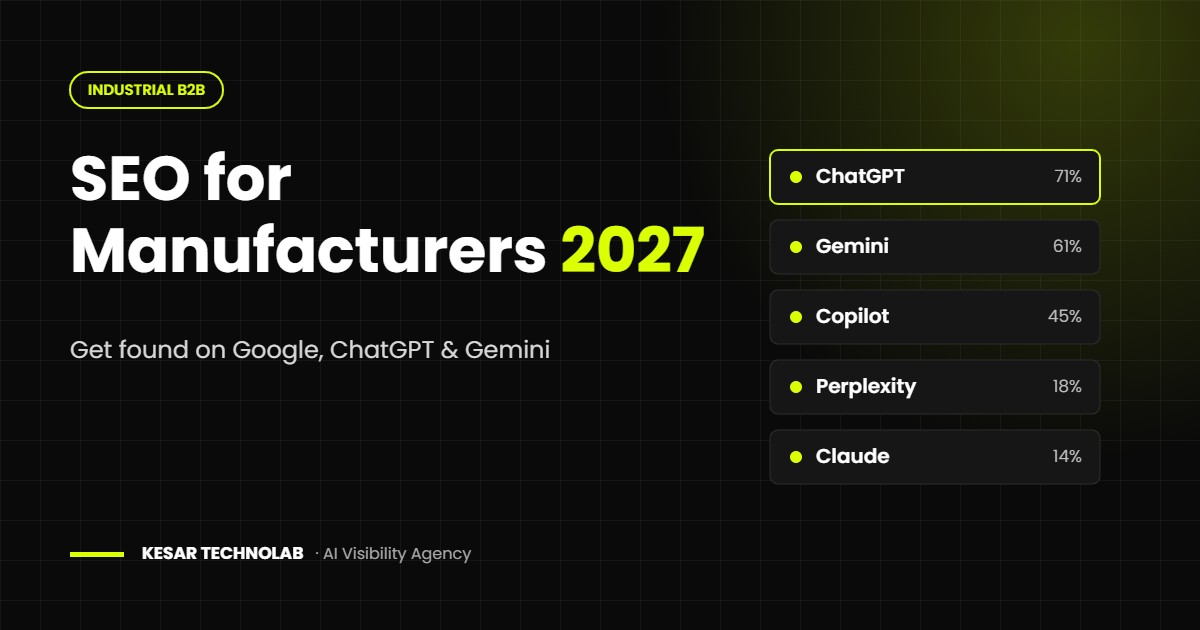
Which assistants do they use for product research? ChatGPT (71%), Google Gemini (61%), Microsoft Copilot (45%), Meta AI (24%), Perplexity (18%) and Claude (14%), among those who use AI at work. The survey covers B2B buyers broadly rather than manufacturing alone, but industrial purchasing follows the same research-first pattern.
Two more shifts matter for manufacturers:
- Buying groups are big. Forrester’s State of Business Buying 2026 found a typical decision involves 13 internal stakeholders and nine external influencers, and procurement is a decision-maker in 53% of buying cycles. Each person may ask an AI something different.
- Industrial directories are going conversational. In January 2026, Thomas launched AI-driven smart search so buyers can describe multi-attribute requirements in natural language. It reported more than 15% more supplier evaluations than its old search during testing.
Why most manufacturer websites are invisible to AI
- Specs live in PDFs and images. Tolerances, materials and capacities sit inside catalogue PDFs or JPG drawings, which AI engines and crawlers extract far less reliably than HTML text.
- One page tries to cover everything. A single “Products” or “Services” page cannot match a query such as “5-axis CNC machining of titanium aerospace brackets”.
- Certifications are logos, not text. An ISO badge in the footer is not the same as a sentence stating the standard, scope and certifying body.
- No commercial facts. Minimum order quantity, lead time, export markets and capacity are missing, so AI cannot answer the buyer’s real question.
- Weak third-party footprint. Outdated directory listings and few independent mentions give AI engines little reason to trust the company.
Prompts your buyers actually type
Industrial prompts are long and specific. Each one tells you which page and which facts you need:
| Buyer prompt | What the AI needs to find | Page to build |
|---|---|---|
| “ISO 9001 certified CNC machining supplier in India for aluminium parts with ±0.01 mm tolerance” | Certification, materials, tolerance, location | Capability page with a spec table |
| “Corrugated packaging manufacturer for FMCG exports to the UAE” | Industries served, export markets, case studies | Industry page plus export-market page |
| “IP67 LED flood light manufacturer with CE and BIS certification, MOQ 500” | Product specs, certifications, MOQ | Product page with full specifications |
| “Alternatives to [competitor] for food-grade PET preforms” | Comparable range, approvals, differentiators | Product range page and an honest comparison page |
| “Lead time for custom stainless steel fasteners, 10,000 units” | Lead times, capacity, process | RFQ and FAQ page with ranges |
SEO for manufacturers: the 10-step plan for 2027
1. Build one page per capability
Create a dedicated page for each process, product family or service: injection moulding, sheet-metal fabrication, rotary die cutting, and so on. Each page should answer what, which materials, which tolerances or sizes, which industries, and how to order.
2. Put specifications in HTML tables
Keep the PDF datasheet for engineers, but publish the key numbers in an HTML table on the page as well: materials, dimensions, tolerances, finishes, capacities and standards. Tables are among the formats AI engines extract most reliably.
3. State certifications in words
Write them out: “ISO 9001:2015 certified by [certification body], scope: design and manufacture of…”. List product approvals such as CE, UL, BIS, FDA or REACH where they apply. AI assistants filter suppliers by these terms.
4. Create industry and application pages
Buyers search by their own industry: automotive, pharma, food and beverage, solar, construction. A page for each major industry, with relevant products, standards and examples, matches how buyers phrase prompts.
5. Create export-market pages
If you sell abroad, publish a page per key market (US, UK, EU, UAE, Saudi Arabia) covering compliance, documentation, Incoterms, typical shipping times and existing customers there. This is how an Indian manufacturer becomes the answer to “supplier in India that exports to Saudi Arabia”.
6. Publish MOQ, lead times and capacity ranges
Exact pricing can stay private, but ranges cannot. “MOQ from 1,000 units, sample lead time 7 to 10 days, production 3 to 5 weeks” lets an AI answer the buyer and recommend you with confidence.
7. Add structured data
Use Organization schema with address, contact points and sameAs links to your directory and social profiles, plus Product schema on product pages. Schema helps machines identify who you are and what you make. Our guide to AI-readable websites covers the details, and our ChatGPT SEO guide explains how ChatGPT chooses sources.
8. Fix your third-party footprint
AI engines check other sources before trusting you. Claim and complete listings on the directories your buyers use, such as Thomasnet for North America, Europages and Kompass for Europe, IndiaMART and TradeIndia for India, plus trade associations, LinkedIn and Google Business Profile. Keep names, addresses and capabilities consistent everywhere.
9. Publish proof with numbers
Case studies with measurable results (“reduced scrap rate from 4% to 1.2%”), plant photos, process videos, test reports and customer logos used with permission. Original evidence is what AI engines quote and what procurement teams forward internally.
10. Make the RFQ path easy and track it
Offer a short RFQ form with drawing upload, WhatsApp or phone for international buyers, and a clear response time. Track form submissions as GA4 events, segment AI referrers, and add “AI assistant (ChatGPT, Gemini, etc.)” as an option in your “How did you hear about us?” field.
How to measure SEO for manufacturers
| Metric | How to track it | Target direction |
|---|---|---|
| AI mentions for buyer prompts | Monthly test of 30 to 50 prompts (see our AI visibility audit checklist), or an AI visibility tool | More prompts where you are named |
| Organic and AI referral traffic | GA4 with segments for chatgpt.com, gemini.google.com, perplexity.ai and copilot.microsoft.com | Up, especially to capability pages |
| Search impressions for capability terms | Google Search Console | Up across long-tail queries |
| RFQs and qualified enquiries | CRM plus GA4 events | Up, with source recorded |
| Directory profile views | Thomasnet, IndiaMART and similar dashboards | Up |
A note for Indian manufacturers selling abroad
Indian manufacturers have a real opening. Overseas buyers increasingly ask AI for suppliers in India, and few Indian factory websites answer those prompts well. Clear English, export-market pages, stated certifications and proof of shipments to the buyer’s country can put a mid-sized plant ahead of much larger competitors. If you are weighing an Indian SEO partner, our guide to outsourcing SEO to India explains what to check. For site rebuilds, see our web development service, for ongoing work see our SEO services, and for the bigger picture read our future of SEO predictions for 2027.
Does ChatGPT recommend your factory, or your competitor’s? We will run your buyers’ real prompts across ChatGPT, Gemini, Copilot and Google, and show you which pages and listings to fix first, free.
Or call +91 63531 74560.
FAQ: SEO for manufacturers
Does SEO work for manufacturing companies?
Yes. Industrial buyers research online long before they contact sales, and in 2026, 66% of US B2B professionals said they regularly use AI to research vendors. Manufacturers with detailed capability pages, specifications and certifications win more qualified RFQs from both Google and AI assistants.
How do I get my manufacturing company recommended by ChatGPT?
Publish clear capability and product pages with specifications in HTML, state certifications in text, add export-market and industry pages, keep directory listings consistent, and earn mentions on industry sites. ChatGPT recommends suppliers it can understand and verify across several sources.
Are PDF catalogues bad for SEO?
They are not harmful, but they are not enough. AI engines and search crawlers extract facts from HTML pages far more reliably. Keep PDFs as downloads and publish the key specifications on the page itself.
How long does SEO take for a manufacturer?
Technical fixes and new capability pages usually show early movement in two to three months. Strong positions for competitive terms and consistent AI recommendations typically take six to twelve months, depending on the market and your third-party footprint.
Which directories matter most for industrial companies?
It depends on your buyers. Thomasnet is important for North America, Europages and Kompass for Europe, and IndiaMART and TradeIndia for India. Trade associations, LinkedIn and Google Business Profile matter in every market.