How to Build a Business Case for AI Visibility Your CFO Will Approve (ROI Model + Memo Template)
Short answer: A strong AI visibility business case doesn’t pitch “more traffic”. It pitches protecting the pipeline you already get from search, plus a new, higher-converting channel. Build a three-line model: pipeline at risk when AI answers your buyers’ questions without naming you, new pipeline from AI referrals, and the program’s cost. Show a downside, base and upside case. Then ask for a 90-day pilot with clear numbers that decide whether it continues or stops.
Who this is for: marketing leads, heads of growth and agency account directors who need finance or leadership to approve an AI visibility budget for AEO and GEO. A copy-paste memo template is at the end.
Key takeaways
- Clicks are falling where AI answers appear. Pew found that Google users who saw an AI summary clicked a traditional result in 8% of visits, versus 15% for users who didn’t see one.
- Being cited still pays. Seer Interactive measured 35% more organic clicks and 91% more paid clicks when a brand was cited in an AI Overview than when it wasn’t.
- Finance is now in the room. G2’s 2026 Buyer Behavior Report found finance involvement in software decisions rose from 31% to 46% in one year. Three in four buyers who had a deal vetoed late now expect positive ROI within six months.
- The strongest AI visibility business case is a time-boxed pilot with leading indicators (citation rate, share of voice, AI referral sessions) and agreed stop rules.
Why does the usual SEO business case fail for AI visibility?
The classic SEO pitch says that ranking higher brings more clicks, and more clicks bring more leads. AI answers break the middle of that chain. Pew Research analyzed 68,879 Google searches from 900 US adults and found that users clicked a link inside the AI summary itself in only 1% of visits. Seer Interactive’s tracking across 42 client organizations found that organic CTR on queries with AI Overviews fell to 0.52% in Q3 2025, down 65.2% year over year.
An AI visibility business case built only on clicks will therefore undersell the work, and leadership will notice when the click numbers don’t move. The AI visibility ROI now sits in two places that clicks don’t fully capture:
- Defense: keeping your share of demand when the answer appears before the links do. In Seer’s data, brands cited in the AI Overview kept a 0.70% organic CTR versus 0.52% for brands that weren’t cited. That gap is about 26%.
- A new channel: AI referral visits are few but tend to convert well. Ahrefs reported that 0.5% of its visitors came from AI search but produced 12.1% of its signups. That is one company’s data, so don’t present it as a guarantee, but it supports the argument.
What will leadership ask, and how should you answer?
| Question | Weak answer | Strong answer |
|---|---|---|
| What’s the problem? | “AI is the future of search.” | “In 31 of our 40 buyer prompts, ChatGPT names competitors and not us.” (Use your own benchmark.) |
| How big is it? | Industry stats only | Your Search Console impressions on AI-affected queries, multiplied by your own conversion rates |
| What do we get? | “Visibility.” | Protected pipeline plus new AI-referred pipeline, in revenue, with three scenarios |
| When? | “SEO takes 6–12 months.” | Leading indicators in 30–60 days, a pipeline read at 90 days, a full ROI read at 6–12 months |
| How do we know when to stop? | No answer | Pre-agreed stop rules, for example: citation rate must rise from X% to Y% by day 90 |
How do you calculate AI visibility ROI?
Use three lines. Each line uses numbers you already have in Search Console, GA4 and your CRM.
Line 1 — pipeline at risk (defense)
Non-brand organic leads per month × share of those queries that show AI answers × CTR gap when you are not cited × lead-to-customer rate × average contract value × 12
Line 2 — new AI-referred pipeline (growth)
Target AI referral sessions in year one × session-to-lead rate × lead-to-customer rate × average contract value
Line 3 — AI visibility budget (cost)
Agency or consultant fees + tools + content and PR production + internal time
AI visibility ROI = (gross profit from lines 1 and 2 − line 3) ÷ line 3
A worked example (illustrative numbers)
The numbers below are made up to show the method. Replace every input with your own.
Take a US B2B SaaS company with a $12,000 average contract value, 80% gross margin and a 15% lead-to-customer rate. It gets 40 non-brand organic demo requests a month. For the CTR gap it uses Seer’s figure: brands that are not cited get about 25.7% fewer organic clicks than brands that are. Its AI visibility budget is $4,000 a month, plus about $10,000 of internal time, for $58,000 in year one.
| Scenario | Key assumptions | Pipeline protected | New AI-referred | Gross profit | AI visibility ROI on $58k |
|---|---|---|---|---|---|
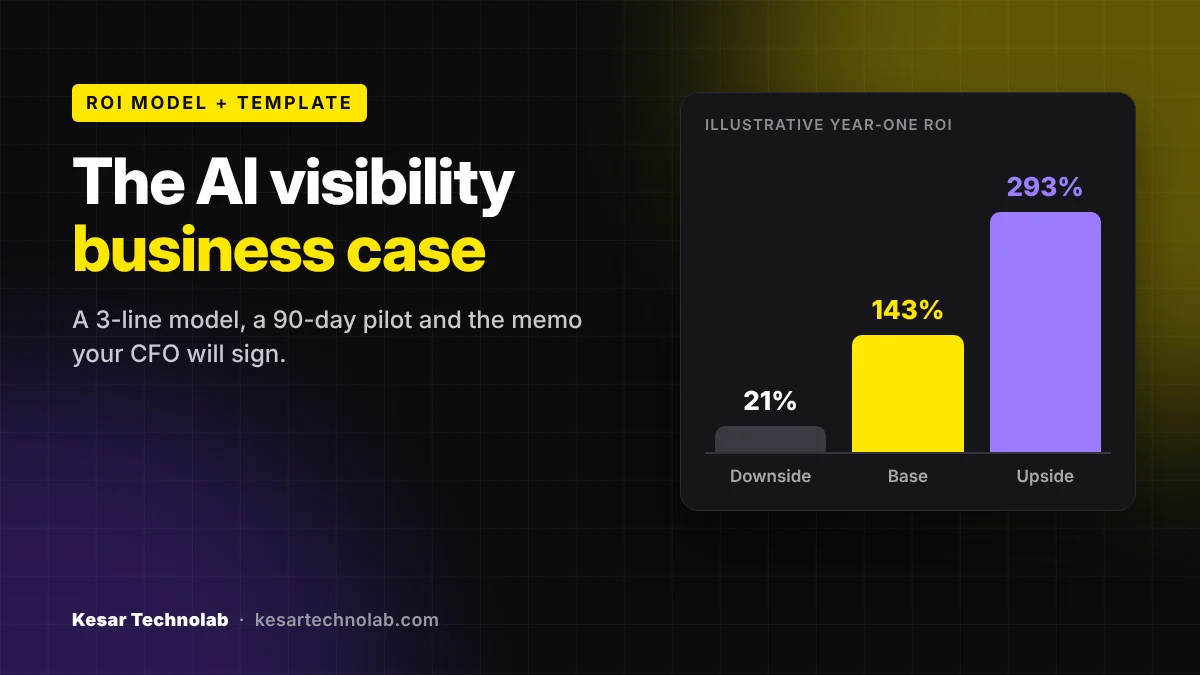
| Downside | 25% of queries show AI answers; 900 AI sessions in year one | $55,543 | $32,400 | $70,354 | 21% |
| Base | 50% of queries; 1,800 AI sessions | $111,086 | $64,800 | $140,709 | 143% |
| Upside | 70% of queries; 3,600 AI sessions | $155,520 | $129,600 | $228,096 | 293% |
AI referrals convert at 2% from session to demo in every scenario. Values are first-year contract value, not recognized revenue. In the base case: 40 × 50% × 25.7% × 12 months ≈ 62 leads protected, × 15% × $12,000 ≈ $111,000. Show the downside case first. An AI visibility business case that still clears its cost in the downside case gets approved far more easily than one that only works in the upside.
What should an AI visibility budget include?
Budgets often fail because hidden costs come out after approval. List every line up front:
- Strategy and delivery: an agency retainer or consultant. Our AI visibility agency pricing guide lists typical 2026 ranges for the US, EU and India.
- Tracking tools: prompt-monitoring software. Our AI visibility tools comparison has verified prices.
- Content and design: comparison pages, data studies and page rewrites.
- Digital PR and reviews: outreach, review programs and expert commentary.
- Developer time: robots and firewall fixes, server rendering, schema.
- Internal time: subject-matter interviews and approvals. This is usually the most underestimated line.
Which metrics prove AI visibility ROI before revenue shows up?
| Metric | How to measure it | When it moves |
|---|---|---|
| Citation rate | Share of your fixed prompt set where you are named or linked | 30–90 days |
| Share of voice | Your mentions ÷ all brand mentions across the prompt set | 60–120 days |
| AI referral sessions | GA4 segment for chatgpt.com, perplexity.ai, gemini.google.com, copilot.microsoft.com and claude.ai | 60–120 days |
| Self-reported AI source | Add “ChatGPT / AI assistant” to “How did you hear about us?” on demo and contact forms | From day one |
| Branded search | Search Console impressions for your brand name | 90+ days |
The self-reported field is the cheapest and most persuasive data you can collect, because it catches buyers who saw you in an AI answer and then typed your URL directly. Our AI visibility audit checklist shows how to build the prompt set behind citation rate and share of voice.
How should you structure a pilot that finance will approve?
- Scope: one product line and one or two markets (for example the US and UK), with 30–50 fixed buyer prompts.
- Baseline: run the prompts across ChatGPT, Gemini, Perplexity and Google AI Overviews in week one, and record AI referral sessions and self-reported sources.
- Work: crawl and rendering fixes, entity consistency, three to five decision pages, and a review and PR push.
- Checkpoints: day 30 (technical fixes done), day 60 (citation rate trend), day 90 (pipeline read).
- Stop rules: agree in writing. For example: “If citation rate has not risen by at least 10 points by day 90, we stop or change approach.”
Stop rules feel risky to write down. In practice they make approval easier, because they cap the downside for the person signing.
How do you answer objections to an AI visibility business case?
| Objection | Answer |
|---|---|
| “We already pay for SEO.” | Good. We estimate 60–70% of the work overlaps with SEO. The rest (prompt benchmarking, entity consistency, review and citation building, AI-specific reporting) usually isn’t in an SEO scope. See AEO agency vs SEO agency. |
| “We can’t attribute it.” | Partly true. That’s why the plan uses three layers: a referral segment, a self-reported field and a fixed prompt benchmark. |
| “It’s a fad.” | OpenAI reported 900 million weekly ChatGPT users in February 2026. The pilot caps the bet either way. |
| “Let’s do it in-house.” | That’s a valid choice if you have a technical SEO, a content lead and a PR owner with spare capacity. Compare the internal time cost with the external cost honestly. |
Copy-paste AI visibility business case memo
Selling into software? Our AI visibility playbook for SaaS covers the pages and proof that get B2B products shortlisted. Pitching this to clients as an agency? See white-label AEO and GEO for agencies.
AI visibility business case checklist
Before you send the memo, check that your AI visibility business case covers each of these points. Finance teams tend to ask about the gaps first.
- Baseline: a fixed prompt benchmark showing where competitors appear and you don’t.
- Demand at risk: Search Console impressions and leads on the queries that now show AI answers.
- Three scenarios: downside, base and upside AI visibility ROI, with the downside shown first.
- Full cost: an AI visibility budget that includes tools, content, PR, developer time and internal time, not only agency fees.
- Leading indicators: citation rate, share of voice and AI referral sessions, with target values for day 30, 60 and 90.
- Attribution plan: a GA4 AI-referral segment and a self-reported source field on forms.
- Stop rule: a written threshold that ends or changes the pilot.
- Owner and review date: one named person and a fixed date to report back.
An AI visibility business case that covers all eight points answers most finance questions before they come up. If one is missing, fix it before the meeting rather than during it.
How Kesar Technolab can help with your AI visibility business case
Send us your Search Console access (read-only is enough), your average contract value and your close rate. We will return a filled-in ROI model and a 20-prompt benchmark showing where competitors appear instead of you, free and with no obligation. We work with teams in the US, UK, Europe, Australia and the Gulf. You can also see how we run AI visibility optimization programs.
Frequently asked questions
How do you calculate AI visibility ROI?
Add the pipeline you protect when AI answers would otherwise name competitors (non-brand organic leads x share of queries with AI answers x the CTR gap when you are not cited x close rate x contract value) to the new pipeline from AI referrals, convert it to gross profit, subtract the program cost and divide by that cost.
How big should an AI visibility budget be for a pilot?
Ask for a fixed 90-day budget covering delivery, a tracking tool, content and internal time. Typical 2026 mid-market agency retainers run about 2,000 to 10,000 US dollars a month in the US, so size the pilot to one product line and one or two markets.
Which metrics show AI visibility is working before revenue?
Citation rate across a fixed prompt set, share of voice against competitors, AI referral sessions in GA4, leads that self-report ChatGPT or another AI assistant as their source, and branded search impressions.
Can AI visibility be attributed in GA4?
Partly. Create a segment for referrers such as chatgpt.com, perplexity.ai, gemini.google.com, copilot.microsoft.com and claude.ai. Because many buyers see you in an answer and then visit directly, add a self-reported source field to your forms as well.
What should the stop rule be for an AI visibility pilot?
Agree it in writing before you start, for example: if citation rate across the agreed prompt set has not risen by at least 10 points by day 90, stop or change the approach.