AI Visibility for SaaS: How to Get Your Software Recommended by ChatGPT, Gemini and Perplexity
Short answer: AI visibility for SaaS means getting your product named when buyers ask ChatGPT, Gemini or Perplexity for a shortlist. AI engines build those shortlists from four places: your own site, review sites (mostly their comparison, alternatives and category pages), YouTube and Reddit, and editorial coverage. To get a SaaS product recommended, make your key pages readable by AI crawlers. Publish plain-text pricing, honest comparison pages and integration pages. Build steady review volume on G2 and Capterra, and earn mentions in the lists that AI engines retrieve. Then test 30–50 real buyer prompts every month and fix the gaps.
Who this is for: founders, CMOs and heads of growth at B2B SaaS companies in the US, UK, Europe, Australia and the Gulf who are losing deals to competitors that keep showing up in ChatGPT, Gemini, Perplexity and Google AI Mode.
Key takeaways
- In G2’s March 2026 survey of more than 1,000 software buyers, 51% said they start software research with an AI chatbot more often than with Google.
- Being named helps even before the click. 85% of buyers in the same survey said they think more highly of a vendor that an AI cites in its answer.
- When AI engines pull from review platforms, about 81% of those retrievals go to multi-vendor pages (comparisons, listicles and category pages), not to individual vendor profiles.
- Your website is still the biggest single source type. Vendor sites made up 63% of retrievals in a 20,160-chat study of software prompts.
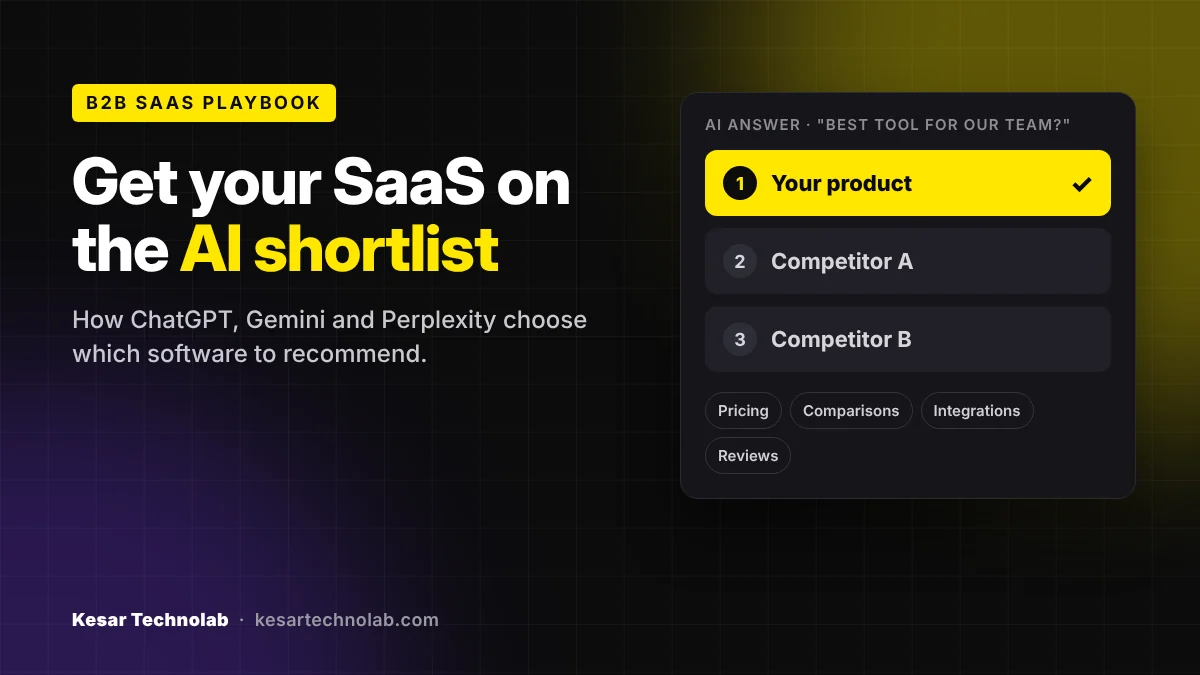
- Treat AI visibility for SaaS as a shortlist problem, not a traffic problem. The real goal is to be one of the three to five names the AI gives when your buyer asks.
Why does AI visibility for SaaS matter more than in most industries?
Software buying has moved into the chat window faster than almost any other category. Buyers now ask an assistant to compare tools and return a shortlist, instead of opening ten tabs and building a spreadsheet. G2’s 2026 AI search report found that 71% of B2B software buyers rely on AI chatbots somewhere in their research, and 69% said a chatbot led them to choose a different vendor than they first planned. One in three bought from a vendor they had never heard of before.
The same research has a warning for vendors. G2’s later 2026 Buyer Behavior Report found that 82% of buyers had sourced software recommendations from an AI chatbot in the previous 24 months. Review sites (38%) also edged past AI chatbots (37%) as the top source shaping shortlists. The two channels feed each other: AI engines read review sites, and buyers check reviews to confirm what the AI told them.
The traffic that does arrive tends to be high-intent. Ahrefs reported that AI search sent 0.5% of its visitors but 12.1% of its signups. That is one SaaS company’s data, not a universal benchmark, but the pattern makes sense. A buyer who clicks through from an AI shortlist has already done most of the comparison.
How do ChatGPT, Gemini and Perplexity decide which software to recommend?
An AI engine answering “best inventory software for multi-location restaurants” runs one or more web searches, reads the pages it retrieves and writes a summary. It never sees most of your website. It sees the few pages that its retrieval step pulls in, plus whatever the model already absorbed in training.
In June 2026, Radyant and OMR Reviews ran 20,160 software-buying chats across ChatGPT, Google AI Overviews, Microsoft Copilot, Claude and Gemini and logged about 156,000 source mentions. The results show where the answers come from:
| Source type | What the study found | What it means for you |
|---|---|---|
| Vendor websites | 63% of all retrievals, spread across hundreds of domains | Your own pages are still the foundation. They must say clearly what you do, for whom and at what price. |
| Review platforms | Comparisons and alternatives pages 36.4%, listicles 22.9%, category pages 22.0%, single vendor profiles 16.8% | Ranking well inside the category and “alternatives” pages matters more than polishing your own profile. |
| YouTube and Reddit | 10.3% and 8.6% visibility, the #2 and #3 single sources | Demo videos and real community answers get pulled into recommendations. |
| Editorial and media | 13% of ChatGPT’s retrievals, above its 8% for review platforms | Digital PR and expert commentary carry extra weight in ChatGPT. |
Google is open about its side. Its documentation says a page only has to be indexed and eligible to show with a snippet to appear in AI Overviews and AI Mode, with “no additional technical requirements”. In practice, SEO fundamentals decide whether you can be retrieved. GEO for SaaS (generative engine optimization) then decides whether you are worth naming once you are retrieved.
Which buyer prompts should a SaaS company target?
Keywords still matter, but buyers type full questions into AI assistants. Group your prompts into six types. Each type needs a different page, and the AI looks for different proof on each one.
| Prompt type | Example | Page you need | Proof the AI looks for |
|---|---|---|---|
| Category | “Best expense software for startups under 50 people” | Use-case or segment landing page | Clear ideal customer, named features, review volume |
| Alternatives | “Cheaper alternatives to [market leader]” | “[Competitor] alternatives” page | Honest trade-offs, pricing difference, migration help |
| Comparison | “[You] vs [competitor] for mid-market” | One-to-one comparison page | A side-by-side table, including where the competitor wins |
| Integration | “Project tool that syncs with HubSpot and Xero” | One page per integration | What syncs, in which direction, setup steps |
| Pricing and cost | “How much does [you] cost for 20 users?” | Plain-text pricing page | Numbers on the page, plan limits, total cost of ownership |
| Problem | “How do I stop stock-outs across 12 locations?” | Answer-first guide or glossary page | A direct answer, steps, data, a product fit that is mentioned but not forced |
Start with 30 to 50 prompts across these six types, written the way your sales team hears buyers talk. Our AI visibility audit checklist explains how to build and score that prompt set. It becomes the baseline for all your SaaS AI visibility reporting.
AI visibility for SaaS: the 8-step playbook
1. Make sure AI crawlers can read your marketing site
Many SaaS marketing sites are JavaScript single-page apps, or sit behind a firewall that challenges unknown bots. Check three things. Is OAI-SearchBot allowed in robots.txt? OpenAI says sites that opt out of OAI-SearchBot will not be shown in ChatGPT search answers. Does your CDN or WAF block AI crawlers by default? Does the main text of your home, pricing, product and comparison pages appear in the raw HTML, not only after JavaScript runs? If your key copy loads only on the client, server-render those pages first.
2. Write one positioning sentence and use it everywhere
AI engines trust a fact more when several independent sources say the same thing. Decide on one sentence: “[Product] is a [category] for [ideal customer] that [main outcome].” Use it on your home page, in your Organization schema, on G2, Capterra, LinkedIn and Crunchbase, and in your press boilerplate. G2’s research found that buyers treat consistency across chatbots as a trust signal. Inconsistent descriptions make buyers dig deeper.
3. Put real numbers on your pricing page
Cost questions come up early in AI-assisted buying. G2 found that understanding total cost of ownership is tied as buyers’ most common use of AI in the buying process (51%, level with building shortlists), and finance involvement in software decisions jumped from 31% to 46% in one year. If your pricing page says “Contact sales” with nothing else, the AI fills the gap with third-party guesses. Publish starting prices, plan limits and what triggers an upgrade. If enterprise pricing is custom, say what it depends on.
4. Publish honest comparison and alternatives pages
Comparisons and alternatives pages are the most-retrieved page type on review platforms, so publish your own versions too. Write one page per major competitor and one “alternatives to [leader]” page. Include a side-by-side table, the use cases where you are the better fit, and the cases where the competitor is. Pages that only praise you read as advertising. Pages that show real trade-offs give an AI something balanced to quote, and they earn more trust from buyers who click through.
5. Build one page per integration
Integration prompts (“works with Salesforce”, “syncs with Shopify”) are some of the highest-intent questions buyers ask. For Supy, a restaurant inventory SaaS, we supported a site with 79 integration pages and localized content in six languages, linked with hreflang, across more than 3,500 indexable URLs. Each integration page should say what data syncs, in which direction, how often, and how long setup takes.
6. Keep review volume steady on G2 and Capterra
In G2’s survey, 45% of buyers said a review-site citation is the most confidence-inspiring signal inside an AI answer. A steady flow of reviews is worth more than one big push a year. Ask customers at moments of success, such as after onboarding or a renewal. Ask them to mention their use case and company size, because those details help AI engines match you to the right prompts. Reply to every critical review in plain, specific language.
7. Make security, compliance and docs pages easy to cite
G2 found that IT security review is the single biggest source of delay in software buying, cited by 39% of buyers and by 50% of enterprise buyers. A public trust page with your certifications, data residency, sub-processors and SSO options helps the AI answer “Is [you] SOC 2 compliant?” correctly. Open help-center articles with a one-sentence answer, so they can be quoted directly.
8. Earn mentions where AI engines look
Get included in the listicles and roundups that already rank for your category. Pitch expert commentary to trade media. Publish short demo videos on YouTube with descriptive titles. Take part in Reddit and community threads as a named person from your team who discloses where they work. Never use fake accounts: communities ban them, and the damage to trust lasts. For ChatGPT in particular, editorial coverage carries extra weight.
What does a 90-day SaaS AI visibility plan look like?
| Weeks | Focus | Output |
|---|---|---|
| 1–2 | Baseline | 40-prompt benchmark across ChatGPT, Gemini, Perplexity and AI Overviews; crawl-access and rendering check; GA4 AI-referral segment |
| 3–4 | Foundations | Robots and WAF fixes, server-rendered key pages, positioning sentence, Organization and SoftwareApplication schema |
| 5–8 | Decision pages | Pricing rewrite, 3–5 comparison pages, 1 alternatives page, top 10 integration pages, trust page |
| 9–12 | Third-party proof | Review program, 5–10 listicle and media pitches, demo videos, re-run the benchmark and compare |
For a comparison of the tools that automate prompt tracking, see our AI visibility tools guide. For ChatGPT-specific tactics, see our ChatGPT SEO guide.
What are the most common SaaS AI visibility mistakes?
- Measuring only clicks. Much of the value of SaaS AI visibility comes from being on the shortlist, and that may never show up as a referral. Add “ChatGPT or another AI assistant” as an option in the “How did you hear about us?” question on your demo form.
- Hiding pricing. If you don’t publish your price, the AI repeats whatever a third-party blog guessed.
- Comparison pages with no trade-offs. One-sided pages are harder for an AI to quote as balanced evidence.
- Ignoring review platforms’ category pages. Your G2 profile matters less than where you appear on the category and alternatives pages.
- Treating llms.txt as a fix. It is harmless to add, but it does not get you cited. We explain why in our llms.txt and schema guide.
Need budget approval first? Use our AI visibility business case and ROI template to make the case to your CFO.
SaaS AI visibility checklist
Use this as a quick audit before you plan the quarter. Each item maps to a step above.
- Crawl access: OAI-SearchBot, PerplexityBot and Googlebot can fetch your home, pricing, product, comparison and integration pages, and your CDN does not challenge them.
- Raw HTML: the main copy of those pages appears in the page source, not only after JavaScript runs.
- Positioning: one sentence describes the product the same way on your site, G2, Capterra, LinkedIn and Crunchbase.
- Pricing: starting prices, plan limits and upgrade triggers are written on the page in plain text.
- Comparisons: you have a page for each of your top three to five competitors and one alternatives page, each with honest trade-offs.
- Integrations: each major integration has its own page explaining what syncs, in which direction and how setup works.
- Reviews: new reviews arrive every month on G2 or Capterra, and critical reviews get a reply.
- Trust page: certifications, data residency, sub-processors and SSO options are public.
- Third-party mentions: you appear in at least some of the listicles, roundups and videos that rank for your category.
- Measurement: a fixed set of 30–50 prompts is tested monthly, AI referrals have their own GA4 segment, and the demo form asks whether the buyer found you through an AI assistant.
If you can tick fewer than six of these, start with crawl access, pricing and comparison pages. Those three usually move AI visibility for SaaS products fastest, because they decide whether you are retrieved at all and what the AI can say about you once you are.
How Kesar Technolab improves AI visibility for SaaS companies
We run AI visibility and SEO as one program, delivering AI visibility for SaaS teams in the US, UK, Europe, Australia and the Gulf. We start with a prompt benchmark, fix crawl and rendering issues, build the decision pages, and report citation rate and AI referral pipeline every month. If you want to see where you stand first, we will run your top 20 buyer prompts across ChatGPT, Gemini and Perplexity for free and show you which competitors appear and why.
Get my free SaaS shortlist check on WhatsApp or book a call through our contact page.
Frequently asked questions
How do I get my SaaS product recommended by ChatGPT?
Make sure OAI-SearchBot can crawl your site, keep key page text in the raw HTML, publish plain-text pricing plus honest comparison and integration pages, build steady reviews on G2 and Capterra, and earn mentions in the listicles and media that ChatGPT retrieves. Then test 30 to 50 buyer prompts every month.
Do review sites like G2 affect AI recommendations?
Yes. In G2's 2026 research, 45% of software buyers said a review-site citation is the most confidence-inspiring signal in an AI answer, and a 20,160-chat study found that about 81% of review-platform retrievals go to comparison, listicle and category pages.
How long does AI visibility for SaaS take?
Technical and crawl fixes can change what AI engines retrieve within weeks. Citation rate usually moves over 30 to 90 days, and pipeline impact is best read after 90 days to 6 months, depending on review volume and third-party coverage.
Is AI visibility for SaaS different from SaaS SEO?
The foundations overlap: indexing, crawlability and useful content. AI visibility adds prompt benchmarking, entity consistency across sites like G2 and LinkedIn, comparison and integration pages written to be quoted, and reporting on citation rate and AI referral pipeline.
Should a SaaS company add llms.txt?
It is harmless to add, but there is no evidence it gets a brand cited. Spend the time on crawl access, server-rendered pages, pricing and comparison pages, and reviews first.