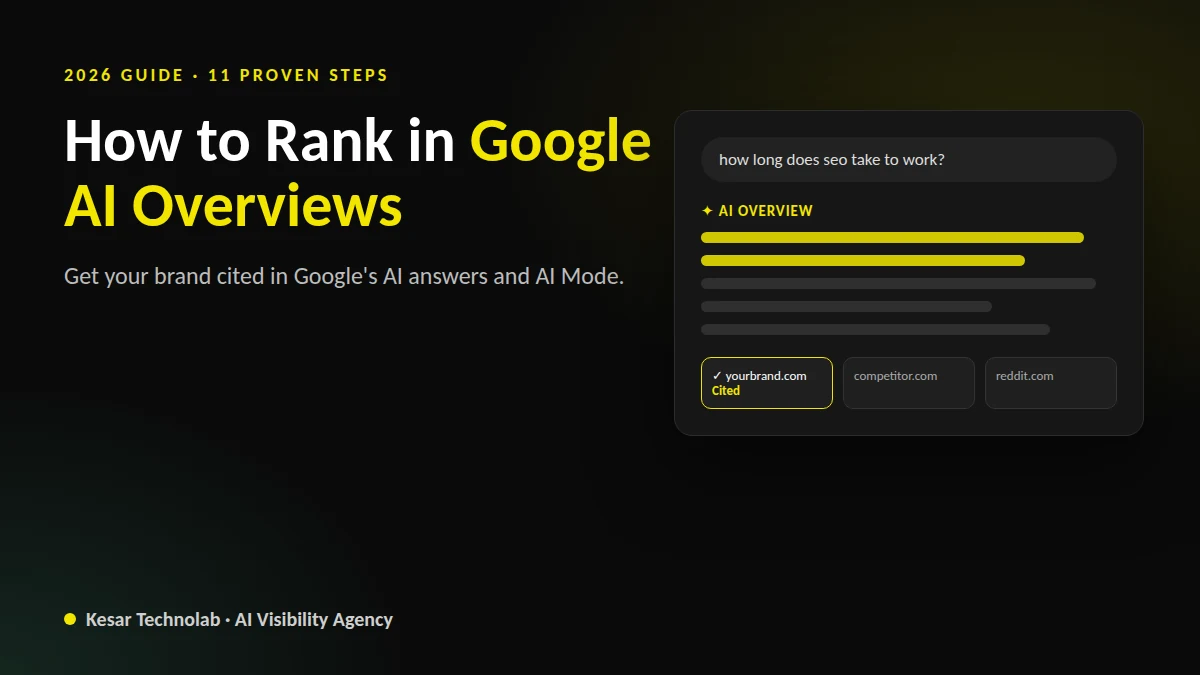
How to Rank in Google AI Overviews in 2026: 11 Proven Steps to Get Cited
Quick answer
To rank in Google AI Overviews, your page must first be indexed and eligible for a normal search snippet. After that, Google AI Overviews cite pages that answer a specific question in the first 40–60 words, back it with a fact the model can quote, and match the long-tail wording people actually type. There is no special tag or schema that forces a citation. Clear answers, topical depth, fresh data and brand mentions on sites like Reddit and YouTube do most of the work.
Google AI Overviews have changed what “ranking” means. In early 2026, 68% of Google searches ended without a click, up from about 60% in 2024, and Google AI Overviews now show up on more than one in five searches. For question-style searches the number is far higher: an 8,500-keyword study by Seer Interactive found an AI Overview on roughly 65% of question-based queries.
So if your buyers in the US, UK, UAE, Australia or India ask Google a question about your category, there is a good chance the first thing they read is an AI summary. Either your brand is cited in that summary, or a competitor is. This guide shows exactly how to rank in Google AI Overviews in 2026, step by step, based on what Google itself says and what the latest citation data shows.
Key Takeaways
- Google AI Overviews use the same index as normal search. If a page is not indexed or blocks snippets, it cannot be cited.
- Google states there are no extra technical requirements for AI features. Foundational SEO is the entry ticket.
- Citations go to pages that give a short, direct, quotable answer near the top, then expand on it.
- Long-tail, conversational queries trigger AI Overviews far more often than short head terms. Target those first.
- Reddit, YouTube and third-party mentions earn a big share of citations. Your off-site presence matters as much as your blog.
- Track results in Search Console and with manual prompt checks. There is no separate “AI Overviews report” yet.
What Are Google AI Overviews?
Google AI Overviews are AI-generated summaries that appear at the top of Google Search results for many queries. They are built by Google’s Gemini models, which read several web pages and write a short answer with links to the sources they used. Those links are the “citations” every brand now competes for.
Google also runs AI Mode, a separate conversational search tab where users can ask follow-up questions. According to Google’s own documentation on AI features and your website, both experiences draw on the same search index and the same ranking systems. That means the work you do to rank in Google AI Overviews also improves your chances in AI Mode.
How Google AI Overviews choose which pages to cite
Google has not published a citation formula, but three facts are confirmed or well supported by data:
- Eligibility: the page must be indexed and allowed to show a snippet. A
nosnippettag or a very lowmax-snippetvalue removes it from the pool. - Query fan-out: for complex questions, Google runs several related sub-searches behind the scenes and pulls answers from pages that rank for those sub-questions. A page that covers a topic in depth has more chances to be pulled in.
- Extractability: the model favours passages it can lift cleanly: a definition, a number, a step list or a comparison. Vague, salesy paragraphs are rarely quoted.
Why Google AI Overviews Matter for Client Inquiries
A citation inside Google AI Overviews does two jobs. It puts your brand name in front of a buyer at the exact moment they are researching, and it signals trust, because Google chose you as a source. Even when the searcher does not click, they remember the brand that “Google recommended”. In practice, this often shows up later as branded searches and direct inquiries rather than as a click from the AI Overview itself.
There is a downside too. If you stay invisible while competitors are cited, you lose demand you never knew existed. That is why AI Overviews optimization is now part of every serious SEO strategy, not a side project.
| Metric | Classic blue-link SEO | Google AI Overviews |
|---|---|---|
| Main goal | Rank a page in the top 10 | Get a passage cited in the summary |
| Best query type | Short head terms | Long-tail questions and comparisons |
| Winning content unit | Whole page | A single answer block or fact |
| Key success metric | Clicks and position | Citations, brand mentions, assisted conversions |
| Off-site signals | Backlinks | Backlinks plus mentions on Reddit, YouTube, reviews |
How to Rank in Google AI Overviews: 11 Proven Steps
This is the process we follow at Kesar Technolab for AI visibility projects. Work through them in order: the first three are about eligibility, the rest are about winning the citation.
1. Confirm the page is indexed and snippet-eligible
Open Google Search Console, run the URL Inspection tool and confirm “URL is on Google”. Then check your page source for nosnippet, data-nosnippet on key sections, or a tight max-snippet rule. Some SEO plugins add these by mistake. Also make sure your robots.txt does not block Googlebot from CSS or JavaScript the page needs to render.
2. Find the questions that actually trigger Google AI Overviews
AI Overviews appear most often for informational, multi-part and comparison queries. Start with your service keywords, then expand them into the questions buyers ask:
- “what is [service] and how does it work”
- “[service A] vs [service B] for small business”
- “how much does [service] cost in 2026”
- “best way to [solve problem] without [common pain]”
Search each one in an incognito window from the country you target (a VPN helps for international markets). Note which queries show an AI Overview and which sites are cited. That list is your target map.
3. Put a 40–60 word answer directly under each heading
This is the single most important on-page change. Under each H2 or H3 that asks a question, write a short answer that could stand alone if it were copied into a summary. Then expand with detail, examples and data below it. This “answer first, detail second” pattern is the core of answer engine optimization (AEO), and it is exactly what you see at the top of this article.
4. Write headings in the same words people search
Use the real question as the heading: “How long does SEO take to work?” rather than “Timelines”. When the heading matches the sub-query Google fans out to, your passage becomes an obvious candidate. Keep one idea per heading so the passage stays focused.
5. Add original facts the model can quote
AI summaries love specific numbers, named sources and dated facts. Add your own data where you can: average project timelines, pricing ranges, benchmark results or survey findings. When you cite third-party data, link the primary source. Pages that give “the number” for a question are cited again and again.
6. Use lists, tables and step-by-step formats
Comparison tables, numbered steps and short bullet lists are easy for a model to extract and for a reader to scan. If a question has a process answer, number the steps. If it has a “which is better” answer, use a table. Keep each list item to one clear point.
7. Build topical depth with a content cluster
Because of query fan-out, a single page rarely wins alone. Build a pillar page for the main topic and supporting articles for each sub-question, all linked together. For example, our guide to AI visibility, AEO and GEO acts as a pillar, while articles such as llms.txt and schema markup and agentic AI search cover the sub-topics.
8. Use schema markup as hygiene, not as a trick
Add Article, Organization, FAQ and (where relevant) Product or Service schema, and keep it consistent with the visible text. Google says structured data must match what users see. Be realistic though: Seer’s 2026 study found no clear link between schema and winning an AI Overview citation. Schema helps machines understand your page; it does not force Google to quote it.
9. Show real experience and a named expert
Add an author bio with real credentials, a “last updated” date, and first-hand details: screenshots, process notes, mistakes you made. Generic content that any AI could write gives Google no reason to prefer your page over the dozens of similar ones.
10. Earn mentions where Google AI Overviews already look
Seer found Reddit alone captured about 20% of AI Overview citations in its dataset, and YouTube also appears often. That means your brand needs a presence off your own site: helpful answers in relevant subreddits (not spam), explainer videos on YouTube, reviews on G2 or Clutch, and guest insights in industry publications. When several trusted sources mention your brand in the same context, AI systems are more likely to repeat it.
11. Refresh content every 60–90 days
AI Overviews favour current information, especially for anything with “2026” in the query. Update statistics, add new examples, and change the “last updated” date only when the content has changed. Re-submit the URL in Search Console after big updates, and use Rank Math’s Instant Indexing to notify Bing and other IndexNow engines at the same time.

Example: Rewriting a Service Page Section for AI Overviews
Here is a simple before-and-after for a question many B2B buyers ask: “How long does SEO take to show results?”
Before (rarely cited): “At our agency, we believe every business is unique. SEO is a journey, and results depend on many factors. Our expert team crafts tailored strategies designed to deliver sustainable growth over time, so get in touch to learn more.”
After (citation-ready): “SEO usually takes 3 to 6 months to show measurable results for a new website and 4 to 8 weeks for an established site improving existing pages. The main factors are domain age, competition, content quality and how quickly Google re-crawls the site. Low-competition, long-tail keywords move first.”
The second version answers the question in the first sentence, gives a number range, names the factors and adds a useful detail. A model can lift any one of those sentences into a summary. The first version says nothing a model can quote. Apply this rewrite to every key question on your service pages, pricing page and FAQ, not just your blog.
A quick self-test: read only the first two sentences under each heading. If a stranger could not act on them, the section is not ready.
Google AI Overviews vs Featured Snippets: What Changed?
Featured snippets quote one page. Google AI Overviews blend several sources into a new answer and cite a handful of them. That shift has three practical effects:
- More brands can win: an AI Overview may cite 3 to 10 sources, so you do not have to be number one to appear.
- Long-tail wins more often: Seer’s data shows AI Overviews lean heavily toward long, specific queries, so smaller sites can compete where big brands have thin coverage.
- Over-optimised pages lose: keyword-stuffed pages that read like they were written for a robot are cited less. Write for the person asking.
Ranking in Google AI Overviews Across Different Countries
AI Overviews are now live in many countries and languages, and the cited sources change by market. A page cited for a query in the US may not be cited for the same query in the UK or the UAE. If you sell internationally:
- Use local spelling, currency and examples where they matter (for example, pricing in USD, GBP, AED and INR).
- Add hreflang tags if you publish separate versions for different regions or languages.
- Get mentioned by local publications, directories and review sites in each target market.
- Check your target questions from each country, not only from your own location.
Our breakdown of AI visibility agency pricing in India, the US and the EU is an example of one page written to serve several markets at once.
How to Track Google AI Overviews Visibility
There is no dedicated report for Google AI Overviews in Search Console yet. Google counts AI feature impressions and clicks inside the normal “Web” search type. Here is a practical tracking setup:
- Search Console: watch impressions for long-tail question queries. A rise in impressions with flat clicks often means you are being shown inside an AI Overview.
- Manual checks: keep a spreadsheet of your 20–50 target questions and check monthly, per country, whether an AI Overview appears and who is cited.
- AI visibility tools: paid trackers now monitor AI Overview citations at scale. They are useful once you have more than 50 target queries.
- Branded search and inquiries: track branded search volume and ask new leads “Where did you first hear about us?” Many will say Google or ChatGPT even without a trackable click.
Common Mistakes That Keep You Out of Google AI Overviews
- Burying the answer after a long introduction or a sales pitch.
- Blocking snippets with plugin settings you forgot about.
- Targeting only short, competitive head terms that rarely trigger an AI Overview.
- Publishing one-off posts with no supporting cluster or internal links.
- Using outdated statistics, or statistics with no source.
- Ignoring off-site presence: no reviews, no Reddit answers, no YouTube videos.
- Expecting schema or an llms.txt file alone to create citations.
Does Ranking in Google AI Overviews Also Help With ChatGPT?
Partly, yes. The same habits (clear answers, original data, strong brand mentions) help across all AI answer engines. But ChatGPT, Perplexity and Gemini use different crawlers and sources, so there are a few extra steps. We cover them in our guide to ChatGPT SEO and how to rank in ChatGPT. If you are deciding who should run this work for you, read AEO agency vs SEO agency first.
Want your brand cited in Google AI Overviews?
Kesar Technolab is an AI visibility agency working with startups and SMBs across India, the Middle East, the UK, the US and Europe. We audit where you appear (and where competitors appear) in Google AI Overviews, AI Mode and ChatGPT, then fix the gaps. talk to our team or explore our AI visibility optimization services.
Frequently Asked Questions About Google AI Overviews
How do I get my website into Google AI Overviews?
Make sure the page is indexed and snippet-eligible, then answer the target question in 40–60 words directly under a matching heading. Support the answer with specific facts, lists or tables, build related articles around the topic, and earn mentions on trusted third-party sites. There is no form or tag to submit.
Is there a special schema or tag for Google AI Overviews?
No. Google’s documentation says there are no additional technical requirements for AI features beyond being indexed and eligible for a snippet. Structured data helps Google understand a page, but it does not guarantee a citation.
How long does it take to appear in Google AI Overviews?
For an established site with good rankings, improved pages can be cited within a few weeks of being re-crawled. For a newer site, expect three to six months, because Google still needs to trust and rank your pages for the underlying sub-queries.
Can I rank in Google AI Overviews without ranking on page one?
Yes, it is possible. AI Overviews often cite pages outside the top organic results, especially for long-tail sub-questions produced by query fan-out. Still, pages with strong organic rankings are cited more often, so traditional SEO remains the foundation.
Do Google AI Overviews reduce website traffic?
They can reduce clicks for simple informational queries, because users get the answer on the results page. But being cited builds brand awareness and trust, which often shows up as branded searches and direct inquiries. The bigger risk is not being cited while competitors are.
How do I stop Google AI Overviews from using my content?
You can use the nosnippet or max-snippet robots meta tags, or data-nosnippet on specific sections. Be aware this also limits normal search snippets, which can reduce clicks from regular results.
Last updated: September 2026. Written by Kaival Desai at Kesar Technolab, an AI visibility agency helping brands get discovered on Google, ChatGPT, Gemini and Perplexity.