
White-Label AEO and GEO for Agencies: How to Add AI Visibility Services Without Hiring a Team
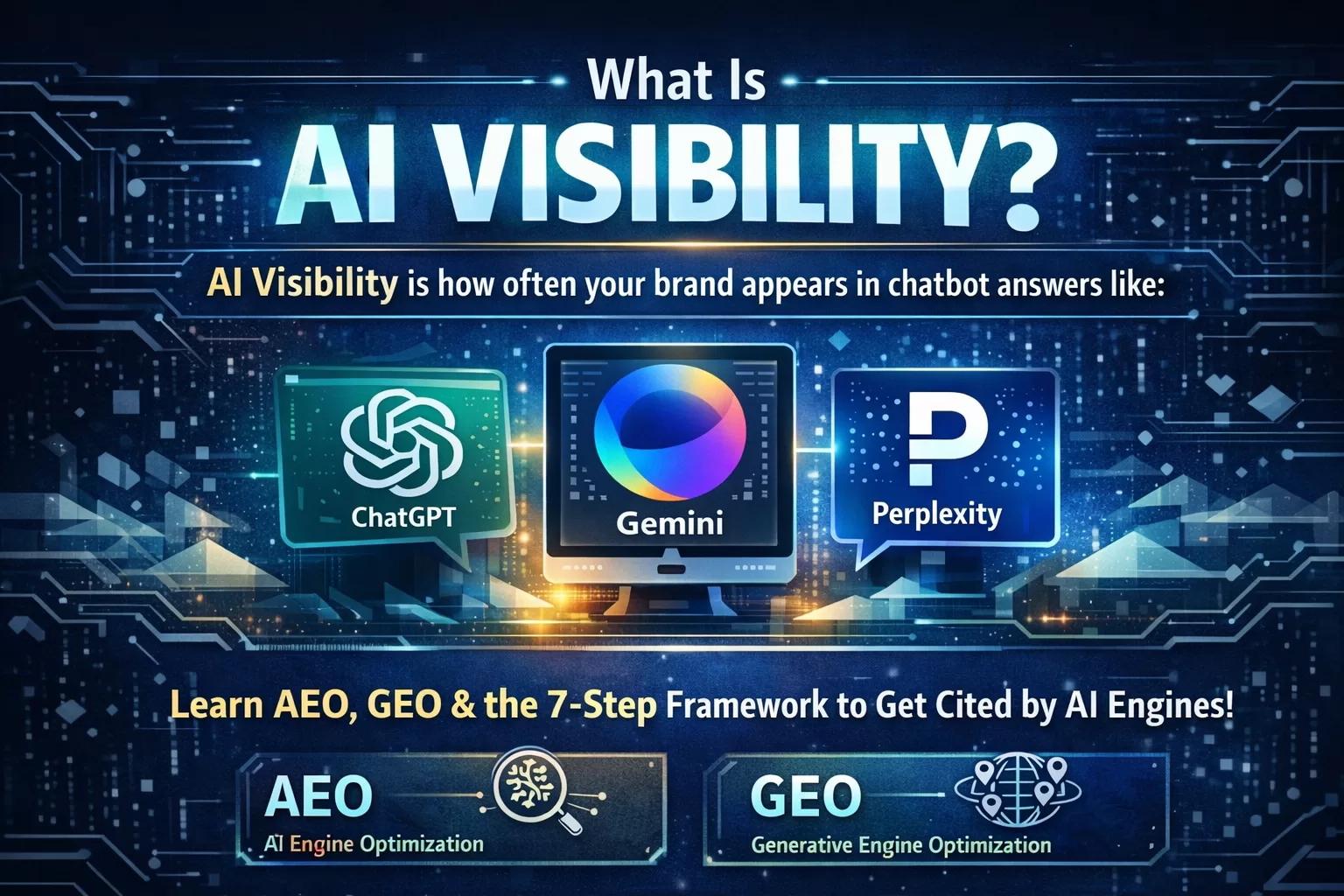
AI visibility is the measure of how often and how prominently your brand appears in answers generated by AI platforms like ChatGPT, Google Gemini, Perplexity AI, Microsoft Copilot, and Claude. Unlike traditional SEO, which focuses on ranking your website in search engine results pages, AI visibility focuses on getting your brand cited, referenced, and recommended inside the AI-generated answers that are rapidly replacing traditional search for millions of users. The two disciplines that drive AI visibility are Answer Engine Optimization (AEO) and Generative Engine Optimization (GEO) — and for startups in 2026, mastering both is no longer optional.
The shift from “10 blue links” to AI-synthesized answers is not a future prediction — it is the current reality. Industry research projects that a quarter of traditional search traffic will migrate to AI chatbots and answer engines by the end of 2026. Nearly 60% of Google searches already end without a click because users get their answers directly from AI Overviews at the top of the page. ChatGPT alone now has hundreds of millions of weekly active users who are asking questions, comparing products, and making buying decisions without ever visiting a website.
For startups and SMBs, this shift is both a threat and an opportunity. The threat is obvious: if your brand is not part of the AI answer, you are invisible to a growing segment of your audience. The opportunity is equally significant: the AI visibility landscape is still early enough that smaller brands with focused strategies can establish citation authority before larger competitors even start paying attention.
The brands that optimize for AI engines now are capturing significantly more visibility than those waiting — and the gap is widening with every passing month.
Understanding the relationship between these three disciplines is essential before you invest in any of them.
Search Engine Optimization (SEO) focuses on ranking your website in organic search results on platforms like Google and Bing. The primary goal is to drive clicks to your website. SEO has been the backbone of digital visibility for two decades and remains critically important — but it is no longer sufficient on its own.
Answer Engine Optimization (AEO) focuses specifically on getting your brand cited in AI-generated answers across platforms like ChatGPT, Perplexity AI, Google AI Overviews, Microsoft Copilot, and voice assistants. While SEO aims for rankings and clicks, AEO aims for citations and brand authority within AI responses. The optimization strategies overlap — both reward high-quality, well-structured content — but AEO requires an additional layer of optimization: making every section of your content independently understandable and every key fact independently citable.
Generative Engine Optimization (GEO) is the broader discipline that encompasses all strategies for optimizing content across generative AI platforms. AEO is a component of GEO — specifically focused on the answer-retrieval layer. GEO also includes strategies for influencing how AI models understand your brand narrative, how they compare you against competitors, and how they recommend your products or services in conversational contexts.
The key insight for startups: you need all three working together. SEO drives the organic traffic that pays the bills today. AEO and GEO build the brand authority that protects your AI visibility as AI search grows. The good news is that most AEO and GEO best practices also improve your SEO performance — well-structured, authoritative, data-backed content ranks better in Google and gets cited more frequently by AI engines. Google’s own guidance on AI features makes the same point: there is no separate checklist for AI search, only a site that machines can read cleanly.
AI answer engines do not rank pages the way Google does. They do not use backlink counts or keyword density as primary signals. Instead, they evaluate content through a different lens:
Entity clarity. AI systems need to understand exactly what your brand is, what it does, who it serves, and how it relates to other entities in the knowledge graph. This is why Organization, Product, Service, and Person schema markup are so important — they provide explicit signals that reduce AI guesswork.
Content structure. AI models extract answers from content that is organized with clear headings, direct question-and-answer patterns, and self-contained sections. A paragraph that can stand alone as a complete answer to a specific question has a much higher chance of being cited than a paragraph buried in a wall of text.
Source authority. AI engines cross-reference information across multiple sources. If your brand is consistently mentioned across authoritative publications, business directories, review platforms, and industry resources, AI models assign higher trust to your content. This is why entity authority building — getting your brand mentioned accurately across high-authority sources — is a core AEO strategy.
Freshness and accuracy. AI platforms favor content that is recently updated and factually consistent. Outdated statistics, stale information, or content that contradicts what other authoritative sources say will reduce your citation likelihood.
Structured data. Research indicates that content with proper schema markup has significantly higher chances of appearing in AI-generated answers. Sites with comprehensive structured data implementation see substantially more AI Overview appearances than those without it.
Here is the exact framework we use at Kesar Technolab to build AI visibility for startup and SMB clients:
Step 1: AI Visibility Audit. Before optimizing anything, you need to know where you stand. Query your brand name, your primary services, and your target keywords across ChatGPT, Gemini, Perplexity, and Claude. Document whether your brand appears, what competitors are being cited, and what information (accurate or inaccurate) is being presented about your business.
Step 2: Entity Foundation. Implement comprehensive schema markup across your website — Organization, Service, Product, FAQ, HowTo, Person (for founders/team), and BreadcrumbList. Ensure your brand entity is consistent across your website, Google Business Profile, LinkedIn, industry directories, and any platform where AI models might source information.
Step 3: Answer-First Content Architecture. Restructure your key pages so that every important section starts with a direct, complete answer before expanding into detail. Use clear H2 and H3 headings that mirror the exact questions your audience asks. Include FAQ sections on every service page and pillar content piece.
Step 4: Topic Authority Building. Build pillar-cluster content architectures around your core topics. If AI visibility optimization is your category, you need definitive content covering every subtopic — AEO, GEO, schema markup, entity optimization, AI citation tracking, and platform-specific strategies. Depth and comprehensiveness signal authority to AI models.
Step 5: Entity Authority Amplification. Get your brand mentioned accurately on high-authority sources that AI models are trained on and actively retrieve from — industry publications, business directories, review platforms, podcast transcripts, and partner websites. Every accurate, consistent mention strengthens your entity in the knowledge graph.
Step 6: Technical SEO Foundation. AI visibility does not replace SEO — it builds on it. Ensure your site is fast, crawlable, mobile-friendly, and technically sound. Fix Core Web Vitals issues, clean up your internal linking structure, and eliminate index bloat. AI systems cannot extract content effectively from sites that are technically broken.
Step 7: Monitor, Measure, Iterate. Track your AI citation performance across platforms. Use tools like Profound, Semrush AI Visibility, or manual prompt testing to monitor how frequently and accurately your brand appears in AI-generated answers. Update content regularly, add fresh statistics, and expand your topic clusters based on what is and is not getting cited.
Ignoring SEO fundamentals. AEO does not replace SEO — it extends it. If your site is slow, uncrawlable, or has broken internal linking, AI systems cannot extract your content effectively. Fix the foundation first.
Publishing volume without structure. AI engines do not reward word count. They reward clarity, structure, and citable facts. One well-structured, 2,000-word guide with clear Q&A sections will outperform ten shallow blog posts in AI citation performance.
Inconsistent entity information. If your business name, address, service descriptions, or team details are inconsistent across your website, Google Business Profile, LinkedIn, and other platforms, AI systems assign lower trust to your content. Entity consistency is non-negotiable.
Not tracking AI citations. You cannot improve what you do not measure. Most startups have no idea whether their brand appears in AI-generated answers — or worse, whether AI platforms are presenting inaccurate information about them. Start monitoring today.
AI visibility is not a vanity metric. When ChatGPT recommends your product to a user who is actively researching solutions in your category, that is a qualified lead arriving with pre-built trust. When Perplexity cites your guide as an authoritative source, that builds brand authority that compounds over time. When Google AI Overviews present your answer at the top of the search page, you capture attention even when users do not click through to your website.
For startups operating with limited budgets, AI visibility offers something traditional marketing channels often cannot: a compounding advantage. Once your brand earns entity authority in the knowledge graph and your content is recognized as a reliable source by AI models, that citation advantage becomes increasingly difficult for competitors to displace.
The window for first-mover advantage is open today. It will not stay open indefinitely.
We built our entire agency around this thesis: the brands that win in 2026 and beyond will be the ones visible to both humans and AI. Our AI Visibility & Optimization service covers the full spectrum — from baseline audits and schema engineering to content restructuring, entity authority building, and ongoing citation monitoring. We work exclusively with startups and SMBs because that is where the biggest opportunity lies.
If your brand is not showing up when prospects ask AI for solutions you offer, we should talk.
+91 63531 74560
AI visibility is the measure of how often and how prominently your brand appears in answers generated by AI platforms like ChatGPT, Google Gemini, Perplexity AI, and Microsoft Copilot. It is driven by Answer Engine Optimization (AEO) and Generative Engine Optimization (GEO).
SEO focuses on ranking websites in traditional search engine results to drive clicks. AEO focuses on getting your brand cited in AI-generated answers across platforms like ChatGPT, Perplexity, and Google AI Overviews. SEO aims for rankings; AEO aims for citations.
Initial structured data and entity improvements can be implemented within 2–4 weeks. Measurable changes in AI citation frequency typically begin within 60–90 days. AI visibility compounds over time — early movers gain advantages that become increasingly difficult to displace.
Yes. Small businesses and startups benefit the most from early AI visibility investment because large enterprises already have established entity footprints. The earlier you build AI authority, the greater your competitive advantage.
Prioritize ChatGPT (OpenAI), Google Gemini and AI Overviews, Perplexity AI, Microsoft Copilot, and Claude (Anthropic). Optimize systemically rather than platform-by-platform — good AEO practices improve visibility across all AI engines simultaneously.