
Agentic Commerce in 2027: How to Get Your Products Found and Bought by AI Agents
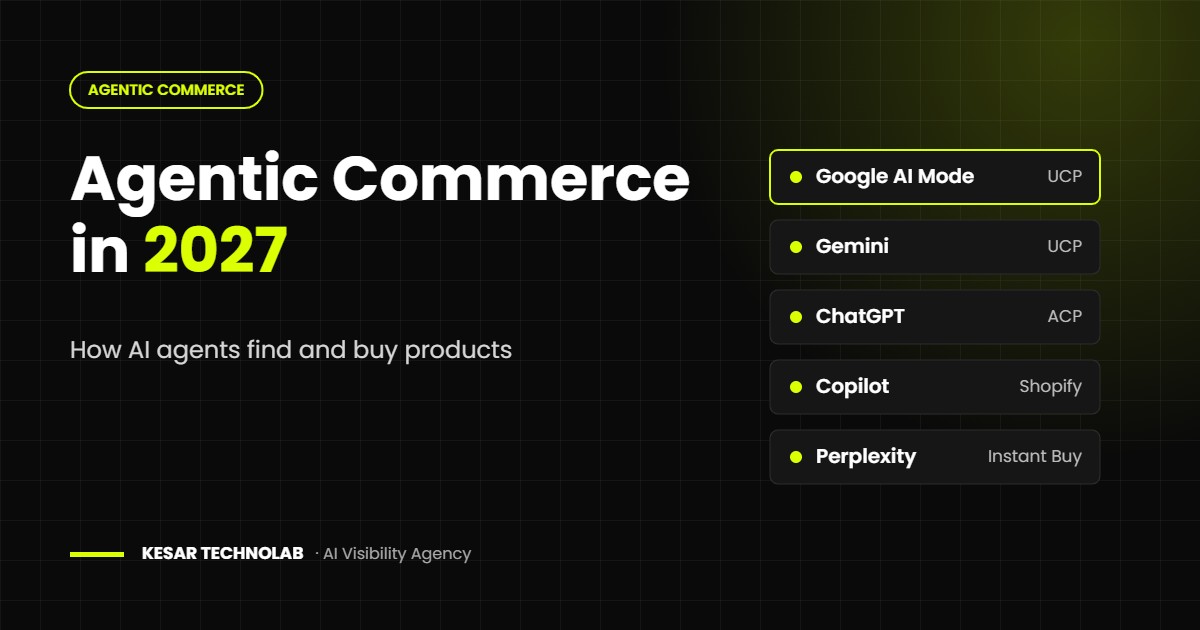
Short answer: Agentic commerce is when an AI assistant such as Google AI Mode, Gemini, ChatGPT, Copilot or Perplexity finds, compares and sometimes buys a product for a shopper. In 2026 the checkout side changed fast: Google and Shopify launched the Universal Commerce Protocol, OpenAI retired ChatGPT Instant Checkout after about six months, and Shopify opened AI channels to millions of merchants. The part that did not change is discovery. If an agent cannot read your product data, it will not recommend you, and it cannot buy what it never recommends. Fixing that is the job for 2027.
What is agentic commerce?
Agentic commerce is shopping where software acts on the buyer’s behalf. It shows up at three levels:
- Level 1, AI-assisted discovery: the shopper asks an AI for options, gets a shortlist, and clicks through to buy on your site. This is where most AI shopping happens today.
- Level 2, in-chat checkout: the shopper confirms the purchase inside the AI interface, and the merchant still fulfils the order.
- Level 3, delegated buying: the shopper sets rules (budget, brand, delivery date) and the agent completes the purchase when the conditions are met.
All three levels depend on the same thing: clean, current, machine-readable product data. That is why agentic commerce is mainly a data problem rather than a design problem. If you are new to this topic, start with our guide to agentic AI search.
What actually happened in 2025 and 2026
The headlines were louder than the reality. Here is the verified timeline:
| When | What happened | Why it matters |
|---|---|---|
| Sept 2025 | OpenAI launched Instant Checkout in ChatGPT, built on the Agentic Commerce Protocol (ACP) co-developed with Stripe. Etsy sellers came first. | First large test of buying inside a chatbot |
| Sept 2025 | Google announced AP2, the Agent Payments Protocol, for payments started by AI agents. | Payment networks began preparing for agent-initiated payments |
| Late 2025 | PayPal and Perplexity launched Instant Buy in Perplexity’s shopping answers. | A second chat-based checkout option |
| Jan 2026 | Google launched the Universal Commerce Protocol (UCP), co-developed with Shopify, for checkout in AI Mode and Gemini. | Google’s open standard for agents to transact with merchants |
| Mar 2026 | OpenAI retired Instant Checkout; ChatGPT now sends shoppers to the merchant to pay. | In-chat checkout proved harder than discovery |
| Mar 2026 | Shopify launched Agentic Storefronts for ChatGPT, Microsoft Copilot, AI Mode and Gemini, managed from Shopify Admin. | Millions of merchants can now switch on AI channels without custom builds |
The lesson: discovery is durable, checkout is still moving
OpenAI’s retreat is the most useful data point of 2026. Reports at the time cited complex merchant integrations and inaccurate or outdated product details (price, stock, delivery) as problems. In other words, the checkout failed where the data failed.
Two practical conclusions for 2027:
- Do not bet your roadmap on one checkout protocol. ACP, UCP and AP2 may merge, change or be replaced. Use what your platform supports and keep your options open.
- Do invest in being the product the agent picks. Every AI surface, with or without checkout, ranks products on data completeness, trust signals and price clarity. That work keeps paying off whatever protocol wins.
The protocols in plain English
| Protocol | Backed by | What it does | Do you need to build it? |
|---|---|---|---|
| UCP (Universal Commerce Protocol) | Google and Shopify, with support from Walmart, Target, Etsy, Visa, Mastercard, American Express and Stripe | Lets AI agents in AI Mode and Gemini check out with merchants while the merchant stays merchant of record | Usually no. Shopify and large commerce platforms handle it; others go through Google Merchant Center |
| ACP (Agentic Commerce Protocol) | OpenAI and Stripe | Open standard that powered ChatGPT Instant Checkout | Low priority after Instant Checkout was retired; watch for OpenAI’s apps-based approach |
| AP2 (Agent Payments Protocol) | Google and payment partners | Rules for proving that a user authorised an agent to pay | No. Your payment provider deals with it |
For most brands the right move is to let the platform carry the protocol work and spend your own effort on product data, content and trust.
Where each AI channel stands for merchants
| AI channel | How shoppers buy today | What you need |
|---|---|---|
| Google AI Mode and Gemini | Checkout on eligible items through UCP for select merchants; otherwise click through to your site | Google Merchant Center feed, accurate prices and stock, complete product attributes |
| ChatGPT | Product discovery in chat, then purchase on the merchant’s store (Shopify uses an in-app browser on mobile) | Crawlable product pages, Shopify Agentic Storefronts if you are on Shopify, strong reviews and mentions |
| Microsoft Copilot | Thousands of Shopify merchants already sell there | Shopify Agentic Storefronts or a Microsoft Merchant Center feed |
| Perplexity | Instant Buy with PayPal on supported products | Indexable product pages and clear specs; check PayPal’s merchant eligibility |
The 9-step agentic commerce checklist for 2027
1. Fix your product feed first
Your feed is the agent’s source of truth. Fill every relevant attribute (GTIN, brand, material, size, colour, compatibility), not only the required ones. Missing attributes mean your product cannot match long, specific queries such as “waterproof hiking boots under $150 with wide fit”.
2. Write product content an agent can compare
Agents compare. Give them facts in plain text: dimensions, materials, use cases, who the product is not for, and how it differs from the alternative. Put key specs in an HTML table, not only inside images. Our ecommerce AI visibility guide shows page templates that work.
3. Add complete Product structured data
Use Product and Offer schema with price, currency, availability, shipping details and return policy, plus AggregateRating where you have genuine reviews. Schema does not guarantee selection, but it removes ambiguity. See our guide to schema markup and llms.txt for what actually matters.
4. Keep price and stock in sync in real time
Stale data is the fastest way to lose an agent’s trust and the shopper’s order. Sync inventory and pricing to your feed and site at least daily, and in near real time for fast-moving SKUs.
5. Make your policies machine-readable
Shipping times, return windows, warranty terms and delivery regions should be on crawlable pages and in your feed. Agents shortlist sellers whose terms they can confirm.
6. Switch on the channels your platform already supports
On Shopify, review Agentic Storefronts in Shopify Admin. Brands not on Shopify can add products to Shopify Catalog through Shopify’s Agentic plan. Everyone selling in Google’s markets should keep Merchant Center clean and watch for UCP eligibility in their country.
7. Let the right AI crawlers in
Check robots.txt and your CDN or firewall rules. Blocking OAI-SearchBot or PerplexityBot keeps you out of those answers. Note that Google-Extended controls Gemini model use of your content; it does not remove you from Google Search or AI Overviews.
8. Earn third-party proof
Agents lean on reviews, comparison articles, forums and marketplaces to decide who is trustworthy. A product with 400 genuine reviews and mentions on independent sites beats a better product nobody talks about.
9. Measure AI-referred revenue
In GA4, segment sessions from chatgpt.com, perplexity.ai, gemini.google.com and copilot.microsoft.com, and watch for utm_source=chatgpt.com on landing URLs. Then track how often AI assistants mention your brand with an AI visibility tool.
What this means for stores in the US, UK, Australia, UAE and Saudi Arabia
| Market | Agentic checkout status (late 2026) | Priority for 2027 |
|---|---|---|
| United States | UCP checkout live for select merchants; Shopify AI channels available | Get feed and schema complete now to qualify early |
| UK and Australia | UCP expansion expected by end of 2026, according to commercetools’ merchant guide | Prepare Merchant Center and product data before rollout |
| UAE and Saudi Arabia | No announced UCP date; AI discovery already influences shoppers | Win discovery: Arabic and English product pages, clear VAT-inclusive pricing, local delivery terms |
| India | Listed as a later UCP market | Focus on AI visibility and fast, trusted on-site checkout |
Building or rebuilding a store for this? Our Shopify development cost guide and UAE ecommerce cost guide cover budgets.
Will AI agents pick your products or a competitor’s? We will test your top products across ChatGPT, Gemini, Google AI Mode and Perplexity and show you exactly what the agents see, free.
Or call +91 63531 74560.
What we expect in 2027
These are our predictions, not announcements (for the wider search picture, see our future of SEO in 2027 predictions):
- Checkout consolidates around a small number of standards, with platforms such as Shopify hiding the protocol choice from most merchants.
- Discovery gets more selective. AI answers show a short list rather than ten blue links, so being product number four is close to being invisible.
- Agent-specific promotions appear. Merchants will set prices, bundles and rules for agent channels, which Google’s UCP tooling already allows.
- Data quality becomes a ranking factor you can see. Products with incomplete or inconsistent data will simply stop appearing.
The brands that win will treat their product catalogue as a public API. That is the core of our e-commerce growth and AI visibility optimisation work.
FAQ: agentic commerce
What is agentic commerce?
Agentic commerce is shopping in which an AI assistant finds, compares and sometimes buys products on a person’s behalf. It ranges from AI-assisted product discovery to in-chat checkout and fully delegated purchases.
Can customers still buy inside ChatGPT?
OpenAI retired Instant Checkout in March 2026. ChatGPT still recommends products, and shoppers complete the purchase on the merchant’s store. Shopify merchants can use an in-app browser on mobile so the shopper does not lose the conversation.
What is Google's Universal Commerce Protocol (UCP)?
UCP is an open standard launched by Google in January 2026 and co-developed with Shopify. It lets AI agents in Google AI Mode and Gemini check out with merchants, while the merchant keeps control of pricing, fulfilment and the customer relationship.
Do small stores need to build ACP or UCP integrations?
Usually not. Platforms such as Shopify handle the protocol work. Small stores get more value from complete product feeds, structured data, accurate stock and pricing, and genuine reviews.
How do I know if AI agents recommend my products?
Run your buyers’ real prompts in ChatGPT, Gemini, Google AI Mode and Perplexity, track mentions with an AI visibility tool, and segment AI referral traffic in GA4. A free AI Visibility Audit from Kesar Technolab gives you a baseline.