AI Visibility Audit: The 2026 Checklist to See If ChatGPT, Gemini and Perplexity Recommend You
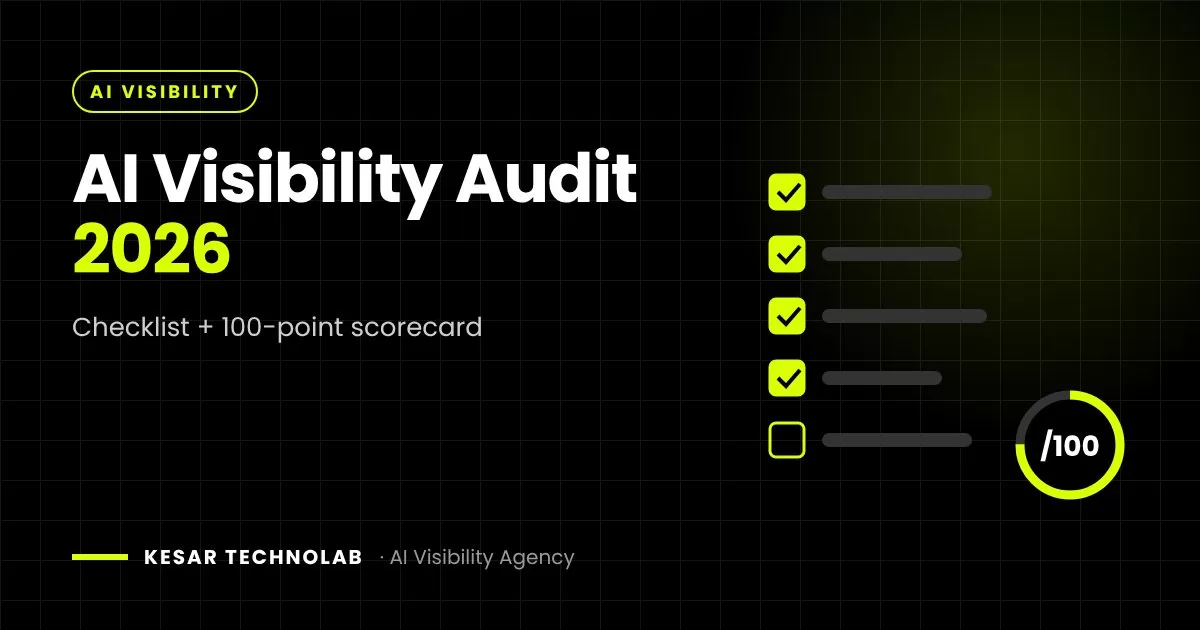
Short answer: An AI visibility audit checks whether ChatGPT, Gemini, Perplexity, Microsoft Copilot and Google AI Overviews can reach your site, understand your brand, and recommend you when buyers ask. It has seven parts: crawl access, index presence, renderability, entity clarity, answer-ready content, off-site citation sources and measurement. Use the 100-point scorecard below to run it yourself in a day, or book our free version at the end.
What an AI visibility audit measures (and how it differs from an SEO audit)
A classic SEO audit asks “Can Google rank this page?” An AI visibility audit asks “When a buyer asks an AI assistant for a recommendation in my category, am I named, am I cited, and is what it says about me true?”
| SEO audit | AI visibility audit | |
|---|---|---|
| Unit of measurement | Keywords and rankings | Prompts and mentions/citations |
| Crawlers checked | Googlebot, Bingbot | Googlebot, Bingbot, OAI-SearchBot, PerplexityBot, Claude crawlers and others |
| Key output | Ranking position, organic traffic | Mention rate, citation share, share of voice vs competitors |
| Off-site focus | Backlinks | Which sources AI engines cite (reviews, listicles, forums, directories) |
| Accuracy check | Rarely | Always: wrong prices, features or locations in AI answers |
You still need both. If you are unsure where your gap is, read AEO agency vs SEO agency first.
Step 0: Build your prompt set
Everything in the audit depends on asking AI engines the questions your buyers actually ask. Write 30–50 prompts across five intent types:
| Prompt type | Example (for a B2B SaaS) | Share of set |
|---|---|---|
| Category discovery | “Best inventory software for restaurants in the UK” | 30% |
| Comparison | “[Your brand] vs [competitor] for multi-site kitchens” | 20% |
| Problem / use case | “How do I reduce food waste across 10 restaurant locations?” | 20% |
| Pricing / buying | “How much does restaurant inventory software cost per month?” | 15% |
| Brand facts | “What does [your brand] do and who is it for?” | 15% |
Tip: add country modifiers (“in the US”, “in Australia”, “UAE”) to the prompts for every market you sell into. AI answers vary a lot by region.
The AI visibility audit checklist (100-point scorecard)
1. Crawl access: 15 points
If AI crawlers are blocked, nothing else matters. Open yourdomain.com/robots.txt and check these user agents:
| User agent | Operator | Purpose | Recommendation |
|---|---|---|---|
| OAI-SearchBot | OpenAI | Surfaces sites in ChatGPT search answers | Allow |
| ChatGPT-User | OpenAI | Fetches pages when a user’s question triggers it | Allow |
| GPTBot | OpenAI | Collects training data for future models | Your choice (training only) |
| PerplexityBot | Perplexity | Indexes and links sites in Perplexity answers | Allow |
| Perplexity-User | Perplexity | User-triggered page fetches | Allow |
| Claude-SearchBot / Claude-User | Anthropic | Search and user-triggered retrieval for Claude | Allow |
| Googlebot / Bingbot | Google / Microsoft | Search indexes behind AI Overviews, Gemini and Copilot | Allow |
Also check your CDN or firewall. Cloudflare began blocking AI crawlers by default on new domains in July 2025, and many WAF “bot fight” settings silently block them too. Your robots.txt can say “allow” while your firewall says “403”.
Score: 15 = all search and retrieval bots allowed at both robots.txt and firewall level. 5 = partially blocked. 0 = blocked.
2. Index presence: 10 points
- Your key pages are indexed in Google Search Console (Google’s AI Overviews and AI Mode draw on Google’s index).
- Your site is verified in Bing Webmaster Tools with a submitted sitemap. Microsoft Copilot runs on Bing, and Bing has historically been one of the sources behind ChatGPT search.
- IndexNow is enabled, so Bing picks up changes quickly. Rank Math and most SEO plugins support it.
3. Renderability: 10 points
Most AI crawlers fetch raw HTML and do not execute JavaScript. If your pricing, features or product details only appear after JavaScript runs, many AI engines see an empty page. Test: disable JavaScript in your browser (or run curl on the URL) and check that your core content is still in the HTML.
4. Entity clarity: 15 points
AI engines need to know who you are before they recommend you.
- Organization schema on your homepage, with
name,url,logo,description,founder,addressandsameAslinks to LinkedIn, Crunchbase, G2/Clutch and social profiles. - The same one-sentence description of what you do on your site, LinkedIn, directories and review profiles.
- A real About page with founders, location, founding year and customers served.
- Product or Service schema on key pages; Article schema with author on blog posts.
For the technical detail, see our guide to llms.txt and schema markup for AI-readable websites.
5. Answer-ready content: 15 points
- Every key page opens with a direct 2–3 sentence answer before the detail.
- You have dedicated pricing, comparison (“you vs competitor”) and use-case pages. AI engines quote these heavily.
- Data sits in tables and lists, which are easy for models to extract.
- Pages show a visible “last updated” date and are refreshed at least twice a year.
- FAQs answer the real follow-up questions from your prompt set.
6. Off-site citation sources: 20 points
This is the part most audits skip, and it often carries the most weight. For each prompt, record which URLs the AI engine cites. You will usually see a pattern: a few “best X” listicles, a Reddit thread, a review platform (G2, Capterra, Clutch, Trustpilot), a directory and a competitor’s comparison page.
- Are you listed on the top 10 domains cited for your category?
- Are your review-platform profiles complete and recently reviewed?
- Are you mentioned in the forums and communities that engines cite?
Score: 20 = present on 7+ of the top 10 cited domains; 10 = 3–6; 0 = fewer than 3.
7. Measurement: 15 points
- A GA4 exploration or segment for AI referrals. Use a session-source regex such as:
(chatgpt\.com|openai\.com|perplexity\.ai|gemini\.google\.com|copilot\.microsoft\.com|claude\.ai) - ChatGPT appends
utm_source=chatgpt.comto many outbound links. Check that your landing pages keep UTM parameters through redirects. - A monthly prompt-tracking baseline, run manually or with a tool. See our comparison of the best AI visibility tools.
- Note: clicks from Google AI Overviews arrive as normal Google organic traffic and cannot be separated in GA4.
How to run the prompt test properly
- Use clean sessions: logged out, or a fresh profile with memory off, so personalisation does not inflate your results.
- Run each prompt 3 times per engine. AI answers vary between runs, so a single run is an anecdote.
- Record per run: mentioned (Y/N), position in the list, cited URL(s), competitors named, sentiment, and any factual errors.
- Calculate:
- Mention rate = runs where you are named ÷ total runs
- Citation rate = runs where your domain is linked ÷ total runs
- Share of voice = your mentions ÷ all brand mentions across the set
- Flag hallucinations. Wrong pricing, discontinued products or the wrong headquarters country are urgent. They usually come from an outdated third-party page you can get corrected.
Reading your score
| Score | What it means | Priority |
|---|---|---|
| 80–100 | AI-ready. Your gaps are competitive, not technical. | Off-site citations and content depth |
| 50–79 | Visible but inconsistent. Engines know you but rarely recommend you. | Entity clarity, comparison pages, review profiles |
| Under 50 | Largely invisible to AI search. | Crawl access, renderability, indexing: fix this week |
The 5 most common failures we see
- A firewall blocks AI crawlers even though robots.txt allows them.
- Pricing is hidden behind “contact us”, so AI engines quote a competitor’s pricing instead.
- No comparison pages, so the engine borrows a competitor’s framing of you.
- Inconsistent brand descriptions across LinkedIn, directories and the website, which confuse entity resolution.
- Missing from the 3–5 listicles that every engine cites for the category.
Selling physical products? The checks are similar, but product feeds and Product schema matter more. See how to get products recommended by ChatGPT, Perplexity and Gemini.
DIY, tool or agency audit?
- DIY (free, 1 day): use this checklist plus a spreadsheet. Good for a first baseline.
- Tool ($29–$500 a month): automates prompt tracking over time. It measures, but it does not fix anything.
- Agency audit: adds the citation-source gap analysis, a fix plan and implementation. One-time audits typically run $1,500–$5,000 in the US. Our AI visibility pricing guide breaks this down by region.
Get a free AI visibility audit from Kesar Technolab
We run this exact audit for startups and SMBs in the US, UK, Australia, the UAE and India: 30+ buyer prompts across ChatGPT, Gemini, Perplexity and Google AI Overviews, a scored report, the citation-source gap list, and a prioritised 30-day fix plan. It is delivered in writing, with no sales call required to receive it.
See exactly where AI assistants recommend your competitors instead of you.
Or call +91 63531 74560. If you are already in good shape, we will tell you.
Want the full service? Explore AI visibility optimization and search engine optimization.
FAQ: AI visibility audits
What is an AI visibility audit?
It is a structured review of whether AI assistants such as ChatGPT, Gemini, Perplexity, Copilot and Google AI Overviews can access your website, understand your brand, and recommend or cite you when buyers ask questions in your category.
How long does an AI visibility audit take?
A DIY baseline with 30–50 prompts takes about one working day. A full agency audit with citation-source analysis and a fix plan usually takes 5–10 working days.
How often should I run an AI visibility audit?
Run a full audit once or twice a year, and track a fixed prompt set monthly. AI answers shift as models and their sources update.
Does blocking GPTBot remove me from ChatGPT?
No. GPTBot collects training data. ChatGPT’s search answers rely on OAI-SearchBot, so blocking OAI-SearchBot is what keeps you out of ChatGPT search results.
Can I check if ChatGPT recommends my brand for free?
Yes. Run your prompt set in a logged-out or memory-off session, three runs per prompt, and log mentions and citations in a spreadsheet. Tools only become necessary when you need to track this over time.
What is a good AI mention rate?
It depends on the category, but if competitors are named in most runs and you appear in fewer than 1 in 5, you have a meaningful gap. Benchmark against your top three competitors, not an absolute number.
Where to read next
- Best AI visibility tools in 2026, compared
- ChatGPT SEO: 9 tactics to get recommended
- How to rank in Google AI Overviews
- What is AI visibility? The complete AEO and GEO guide
Sources: OpenAI crawler documentation; Perplexity crawler documentation; Anthropic crawler documentation; Vercel, “The rise of the AI crawler” (JavaScript rendering); MIT Technology Review on Cloudflare’s default AI-bot blocking. The scorecard weights are Kesar Technolab’s methodology. Last reviewed: October 14, 2026.